

A guide to the perfect sleep schedule for a 6 month old baby
You made it to the six-month mark. The hazy newborn days are fading, and you might see a more predictable rhythm emerge in your baby's day. This is a big deal.
At six months, your little one's sleep patterns are beginning to mature. Let's break down what is happening so you can set realistic expectations and create a routine that works for your family.
Decoding your 6-month-old's sleep needs
So, what is actually going on with their sleep? Your baby's sleep cycles are becoming more like an adult's. This is fantastic news. It means they are capable of longer, more consolidated stretches of rest, especially overnight. Here is why a more defined sleep schedule for your 6-month-old baby starts to feel possible.
What to expect from sleep at this age
First, let's talk numbers. Knowing how much sleep your baby needs is the foundation of building a good routine. For a six-month-old, that sleep is split between nights and daytime naps.
- Total Sleep: You are looking at around 14 hours of total sleep in a 24-hour period.
- Night Sleep: Most babies will sleep for an 11 to 12-hour stretch overnight. This might still include a feed or two. Do not stress if it does.
- Daytime Naps: Expect two to three naps during the day, which should add up to about 2.5 to 3.5 hours.
In Australia, the journey for a six-month-old usually involves this shift towards more solid nighttime sleep. Most babies at this age get roughly 12 to 15 hours of sleep in total. Nighttime stretches can last anywhere from 6 to 8 hours at a time. The Raising Children Network confirms these figures, stating babies need 12-16 hours of sleep every 24 hours, including 2-3 day sleeps. (Source: Baby sleep: 2-12 months, Raising Children Network, 14 May 2024).
Next steps, here is a quick overview of what to aim for.
Typical 6-month-old sleep at a glance
This table gives you a clear benchmark for average sleep patterns. Remember, every baby is different, so think of this as a guide, not a rulebook.
| Metric | Average Range (per 24 hours) |
|---|---|
| Total Sleep | 12-15 hours |
| Nighttime Sleep | 11-12 hours |
| Daytime Naps (Total) | 2.5-3.5 hours |
| Number of Naps | 2-3 |
| Awake Time (Wake Windows) | 2-3 hours |
Having these numbers in your back pocket can help you spot when your baby is tired. It can also help you build a routine that lines up with their natural rhythm.
A crucial element for quality sleep is the comfort and safety of their sleeping surface. For guidance on this, you might look into the best mattress for kids. A supportive and safe sleep environment is the foundation of any successful sleep schedule.
Developmental leaps and their impact
Just when you feel like you have cracked the code, a developmental leap can throw a spanner in the works. This is totally normal. At six months, your baby is incredibly busy mastering some amazing new skills.
They might be:
- Sitting up on their own.
- Rolling from their back to tummy and then back again (often in the cot, at 3 am).
- Becoming way more socially aware and fascinated by everything around them.
These exciting milestones can sometimes trigger what parents call a "sleep regression." Your baby might want to practise their new rolling skills instead of sleeping. They might just find it harder to switch off their busy little brain. This is a completely normal part of their development. Knowing this helps you stay patient.
Understanding what is happening biologically allows you to create a practical, flexible schedule that works with your baby, not against them. Now, let’s look at how to build that routine.
Creating a flexible sleep routine that works
Building a solid sleep schedule for a 6 month old baby is less about watching the clock and more about tuning into your little one's natural rhythm. The real goal is to create a flexible routine that fits your family, not the other way around. To do this, we will focus on two game-changing concepts: wake windows and sleep cues.
Forget staring at the time. Instead, you will learn to watch your baby. This helps you respond to their needs before they get overtired, which is nearly always the culprit behind those tricky naps and fussy evenings.
Understanding wake windows
The secret to a happier, better-rested baby often comes down to their wake windows. That is the sweet spot of time they can comfortably stay awake between sleeps. For a six-month-old, you are generally looking at 2 to 3 hours.
Think of it like a little battery. When they wake up, it is fully charged. As they play, explore, and interact, that battery slowly drains. A wake window is the ideal amount of time before that battery gets critically low, leading to an overtired, cranky baby.
Here is a rough guide to how these windows often stretch out across the day:
- Morning Window: This is usually the shortest, around 2 to 2.5 hours.
- Midday Windows: These tend to get a little longer, closer to 2.5 hours each.
- Pre-Bedtime Window: This is the longest stretch of the day, lasting up to 3 hours. It is designed to build up just enough sleep pressure for a good, long night's rest.
Paying attention to these windows helps you anticipate when your baby will be ready for their next nap. This makes the whole process of settling them down so much smoother. It is a huge shift from the newborn days. If you want a reminder of just how far you have come, you can look back at our guide on the sleep schedule for a 3-month-old.
This visual breaks down how a 6-month-old’s sleep is typically split between nighttime and daytime naps.
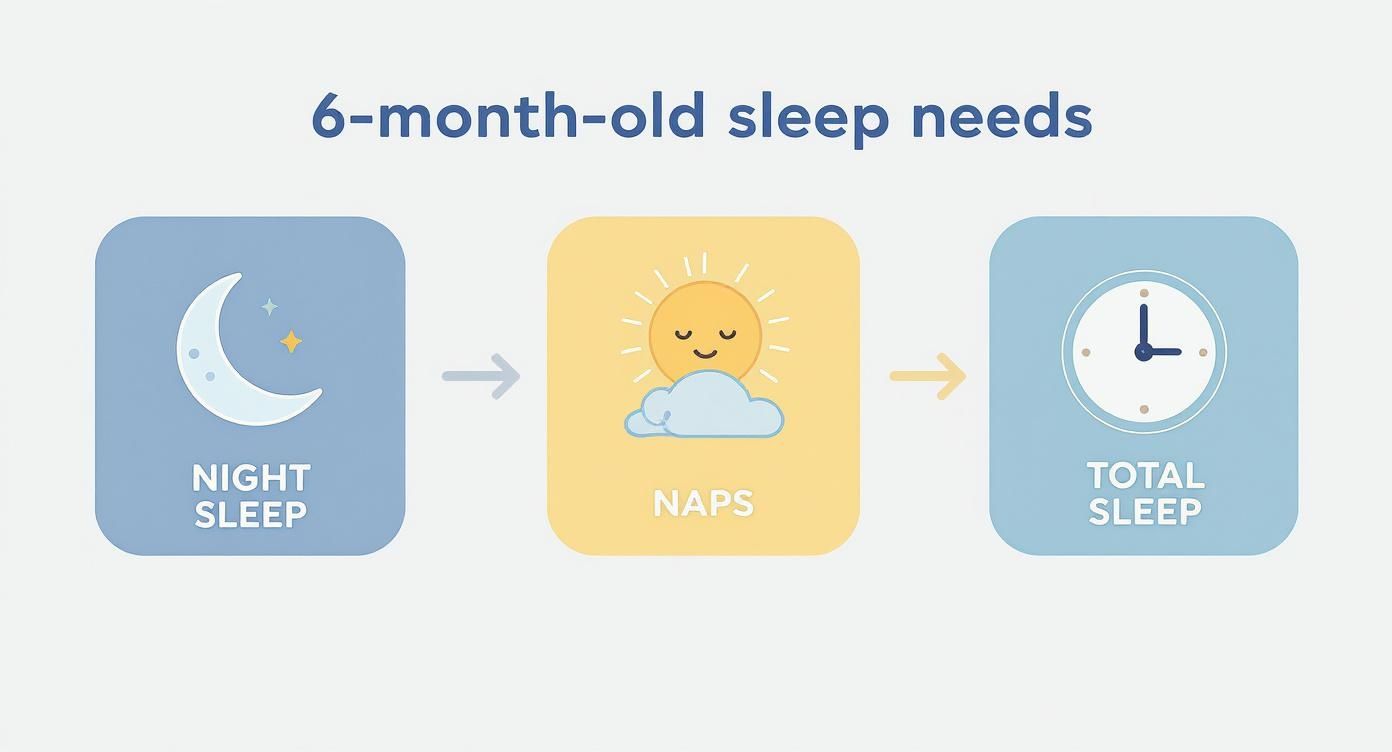
As you can see, the bulk of their sleep happens overnight, but those daytime naps are absolutely crucial for preventing an overtired meltdown.
Spotting your baby's unique sleep cues
Along with wake windows, your baby will give you little hints that they are getting tired. Think of these sleep cues as your personal cheat sheet. Learning to spot them early is a game-changer.
Keep an eye out for these early signs:
- Staring off into space or looking a bit "zoned out"
- Becoming quieter and less interested in their toys
- A subtle rub of the eyes or a little tug on the ear
- Small, soft yawns
These are your golden moments to start winding down for sleep. If you miss them, you will start seeing the late cues: fussing, arching their back, or full-blown crying. By then, they are already overtired, and getting them to settle will be a much bigger battle.
The aim is to put your baby down when they are drowsy but still awake. This is so important for helping them learn the skill of falling asleep on their own, which is key for connecting sleep cycles and sleeping for longer stretches.
Sample sleep schedules: a realistic guide
To help you visualise how this all comes together, let’s walk through a couple of common daily flows. Remember, these are just frameworks, not strict rules. Your baby’s wake-up time and nap lengths will change from day to day, and that is completely normal.
Scenario One: The three-nap day
Many six-month-olds are still happily on three naps. This kind of schedule works well for babies who tend to take shorter naps or have slightly shorter wake windows.
| Time | Activity |
|---|---|
| 7:00 AM | Wake Up & Feed |
| 9:00 AM | Nap 1 (Wake window: 2 hours) |
| 10:30 AM | Wake Up & Feed |
| 1:00 PM | Nap 2 (Wake window: 2.5 hours) |
| 2:30 PM | Wake Up & Feed |
| 5:00 PM | Nap 3 (Wake window: 2.5 hours) |
| 5:45 PM | Wake Up & Feed |
| 7:45 PM | Bedtime (Wake window: 2 hours) |
Scenario Two: Transitioning to two naps
As your baby gets closer to seven months, or if you notice their naps are naturally getting longer, you might see a shift towards a two-nap day. This usually happens when they start fighting that third nap or it begins pushing bedtime way too late.
| Time | Activity |
|---|---|
| 7:00 AM | Wake Up & Feed |
| 9:30 AM | Nap 1 (Wake window: 2.5 hours) |
| 11:00 AM | Wake Up & Feed |
| 2:00 PM | Nap 2 (Wake window: 3 hours) |
| 3:30 PM | Wake Up & Feed |
| 7:00 PM | Bedtime (Wake window: 3.5 hours) |
Notice how the wake windows get longer in the two-nap schedule? That is to make up for the dropped nap. During this transition, do not be afraid to pull bedtime forward (even as early as 6:00 PM) on some days to avoid overtiredness.
The most important thing is to stay flexible. If a nap is unexpectedly short, you might need to shorten the next wake window or bring bedtime forward a bit. By combining your knowledge of wake windows with your baby's individual cues, you can create a predictable and positive routine that helps everyone get the rest they need.
Mastering soothing bedtime and nap routines
A predictable routine is probably the single most powerful tool you have for signalling sleep to your six-month-old. Think of it as a gentle heads-up for their body and brain that rest is coming. Creating these small, consistent rituals is the secret to helping your baby wind down and build positive, comforting feelings about sleep.
Here is why it is so effective. Babies genuinely thrive on predictability. When the same sequence of events happens before every sleep, it becomes a powerful cue. It helps them shift from active play to a calm state, making it so much easier for them to drift off.

Building your ideal bedtime ritual
Do not worry, your bedtime routine does not need to be complicated or long. The real goal is consistency and calm, not complexity. Aim for a sequence that lasts around 20 to 30 minutes and moves you both progressively closer to the cot.
Let's break down some simple, effective things you can mix and match to find what works best for your family.
A great routine might include a few of these steps, always in the same order:
- Warm Bath: A classic for a reason. That slight drop in body temperature after a warm bath naturally helps to bring on sleepiness.
- Change into Pyjamas: Head into the dimly lit bedroom to change into PJs and a fresh nappy. This signals a clear shift away from the busy parts of the day.
- Final Feed: Offer a calm, quiet feed in the nursery. If you can, try to offer this feed earlier in the routine rather than right at the end to help separate feeding from the act of falling asleep.
- Gentle Massage: A few minutes of a gentle baby massage with a baby-safe lotion can be wonderfully soothing and a lovely bonding moment.
- Read a Story: Reading one or two short, familiar books in a soft voice helps your baby relax. The sound of your voice is incredibly comforting for them.
- Cuddles and a Song: End with a quiet cuddle and a lullaby before placing them into their cot drowsy but still awake.
For babies who are still swaddled or transitioning out of one, this is a great time to get them snug. If you are looking for guidance on safe wrapping techniques, it can be helpful to learn more about how to wrap a baby as part of your routine.
A consistent bedtime routine is more than just a series of steps. It is a powerful signal that communicates safety, predictability, and love to your baby. It helps them feel secure enough to let go of the day and fall asleep.
Creating a simple naptime routine
Your nap routine should be a much shorter, condensed version of your bedtime ritual. It does not need a bath or pyjamas, of course, but it should still clearly signal that sleep is on its way. This helps your baby transition from being alert and playful to being ready for rest.
This "mini-routine" should only take about 5 to 10 minutes.
Here is an example of what a simple and effective nap routine could look like:
- Dim the Lights: Close the curtains to create a dark, sleepy environment.
- Change Nappy: A quick nappy change ensures they are comfortable.
- Sleep Sack: Put your baby into their sleeping bag or swaddle.
- Quiet Song: Sing the same brief lullaby you use at bedtime.
- Key Phrase: Say a consistent phrase like, "It's sleepy time, I love you."
This consistency helps your baby recognise that it is time for a nap, even during the bright, busy daytime hours. It is a small step that can make a huge difference in how easily they settle.
Tackling common nap struggles
One of the biggest frustrations for parents at this age is the dreaded "catnap". This is that short little nap that lasts only 30 to 45 minutes. This usually happens when a baby wakes after just one sleep cycle and cannot quite figure out how to link to the next one.
If you are struggling with short naps, here are a few gentle strategies to try.
- Check the Wake Window: The most common culprit for short naps is an incorrect wake window. If your baby is either overtired or undertired, they will struggle to connect sleep cycles. Try adjusting the wake window by 15 minutes (either way) to see if it helps.
- Optimise the Sleep Environment: Make sure the room is as dark as possible. Even small amounts of light can signal to a baby that it is time to wake up. White noise can also be a lifesaver for muffling household sounds that might startle them awake between cycles.
- Wait a Moment: When your baby stirs or fusses after 30 minutes, try to wait just a few minutes before going in. Sometimes, they are just transitioning between sleep cycles and will resettle on their own if given the chance.
Remember, the goal is to build positive sleep habits through gentle consistency. By mastering these soothing routines for both bedtime and naps, you are giving your baby the predictable cues they need to feel secure and grow into a confident little sleeper.
Navigating night wakings and feeds with confidence
Waking up at night is completely normal for a six-month-old. However, how you handle these interruptions can make a huge difference to your whole family's rest. It is easy to assume every cry means hunger, but at this age, your baby could be waking for so many other reasons.
Next steps. The goal here is to create a clear, calm plan for those middle-of-the-night moments. This consistency is what helps your baby learn to link their sleep cycles, which is the real key to sleeping for longer stretches.

Hunger vs comfort: is a night feed still necessary?
This is the big question for so many parents: does my six-month-old really still need to eat overnight? The answer is maybe. Many babies are developmentally capable of sleeping through without a feed. However, it is also very common for them to still need one or even two feeds, especially if they are breastfed.
You can start to tell the difference between a genuine hunger wake-up and one that is just for comfort. A truly hungry baby usually wakes at a pretty consistent time, feeds eagerly, takes a full feed, and then settles back to sleep without much fuss.
On the other hand, a baby waking for comfort might:
- Wake at random, unpredictable times all through the night.
- Only take a tiny bit of milk before dozing off again at the breast or bottle.
- Settle with other methods, like a simple cuddle or a hand on their chest.
If you suspect your baby is waking more for comfort than hunger, it could be a sign of a sleep association. This is incredibly common and something you can gently work on. These patterns can sometimes feel a bit like other sleep disruptions, which you might recognise from our guide on the four-month sleep regression.
The role of daytime feeds in nighttime sleep
One of the best ways to encourage longer sleep at night is to make sure your baby is getting enough calories during the day. At six months, your baby is so much more aware of the world. This can lead to very distracted daytime feeds. They might pull away to look at something interesting, which often results in "snacking" rather than taking proper, full feeds.
To combat this, try offering feeds in a quiet, dimly lit room with as few distractions as possible. This encourages them to focus and get the calories they need while they are awake. This makes it less likely they will try to make up for it overnight.
Your main goal should be to shift the bulk of your baby's calorie intake to their waking hours. A baby who is well-fed during the day is biologically more prepared to sleep for longer stretches at night.
Gently reducing night feeds when ready
If you and your paediatrician agree that your baby is ready to cut back on night feeds, the key is to do it gradually and gently. Stopping feeds abruptly can be really upsetting for both you and your baby.
Here are a couple of gentle strategies you can try:
- Reduce Feeding Time: If you are breastfeeding, try cutting the feed by a minute or two every couple of nights. For bottle-fed babies, you can reduce the amount in the bottle by 10-20ml.
- Offer Comfort First: When your baby wakes, try other soothing methods for a few minutes before immediately offering a feed. You might find a gentle pat or a shushing sound is all they need to resettle.
Remember, this is not a race. The right sleep schedule for a 6 month old baby is one that feels right for your family. Responding to your baby's needs with a consistent and loving plan is the most effective way to guide them towards better, longer sleep.
Troubleshooting common 6 month old sleep problems
Just when you think you have finally cracked the code on your baby’s sleep, everything changes. It is a classic parenting story, and it is a completely normal part of your baby's development. Knowing what these common hurdles are helps you respond with a plan instead of panic. This keeps all your hard-won progress on track.
Navigating these challenges really comes down to patience and consistency. Remember, these phases are almost always temporary disruptions, not a sign that your sleep schedule for a 6 month old baby has failed.
The famous 6 month sleep regression
If your baby's sleep suddenly takes a nosedive, you have probably run into the infamous six-month sleep regression. But "regression" is not really the right word for it. It is more of a progression in their development that throws a temporary spanner in the works.
At this age, your baby is busy mastering some seriously exciting new skills. These include sitting up, babbling, and becoming much more aware of the world around them. Their little brain can be so switched on that it is hard for them to switch off. This is why you might find them practising their new rolling skills in the cot at 3 AM instead of sleeping.
To get through it:
- Offer lots of practice time: Give your baby plenty of floor time during the day to work on all those new physical skills. If they can get that urge to practise out of their system while they are awake, they are less likely to do it in the cot.
- Stay consistent: Stick to your calming bedtime and nap routines as much as you possibly can. That predictability is incredibly reassuring for your baby when their world is changing so quickly.
The real secret to surviving any sleep regression is to avoid creating new, unsustainable sleep habits out of desperation. Keep your routines solid, offer a little extra comfort, and trust that this phase will pass.
When you are trying to solve sleep issues, it is so easy for your own mind to get tangled up in worry. Learning how to calm your mind from overthinking is a powerful skill that can help you stay grounded and patient through these tricky phases.
Teething troubles and sleep
Teething can absolutely make it harder for a baby to settle and stay asleep. The discomfort from sore gums is very real, and it often seems to ramp up at night when there are fewer distractions. You will probably notice more fussiness, a whole lot more drool, and a desire to chew on absolutely everything.
But let's put it in perspective. If teething is the true culprit, the intense discomfort usually only lasts for a few days as the tooth actually pushes through the gum.
Here is what you can do:
- Offer relief during the day: Provide safe teething toys, a cold, damp flannelette, or teething rusks during their awake time to help soothe their gums.
- Talk to your GP or pharmacist: If your baby seems to be in significant pain, it is always best to consult a healthcare professional about appropriate pain relief options for their age and weight.
- Give extra comfort: A few more cuddles before bed can go a long way. Just be mindful of not accidentally creating a new habit where they need to be held to fall asleep every single night.
Coping with illness and travel
Sickness and travel are two of the biggest disrupters to any baby's sleep. When your little one is sick with a cold or fever, their need for comfort skyrockets. During this time, you can bend all the usual rules. Just focus on cuddles, hydration, and whatever it takes to help them feel better.
Do not worry about long-term habits when they are unwell. As soon as your baby is healthy again, you can confidently and immediately go straight back to your established routine. They will get back on track faster than you think.
Travel can be just as tricky. A new environment, a different time zone, and a thrown-off schedule can really throw sleep into disarray. Try to replicate their home sleep environment as much as possible. Bring their sleeping bag, white noise machine, and a few favourite books. Sticking to your usual nap and bedtime routines, even loosely, provides a welcome sense of predictability.
If you are dealing with this, you are not alone. These disruptions are an incredibly common experience for parents in Australia. A study in the Australian Journal of General Practice found that 33.85% of parents of 6–8 month olds reported sleep problems, making it the most common age for such concerns. (Source: An approach to common sleep presentations in infants and young children in general practice, The Royal Australian College of General Practitioners, June 2024). This period is just naturally marked by big shifts in sleep patterns. You can find more insights about common infant sleep presentations in Australia in the study.
Your questions on baby sleep schedules answered
Even with the best plan, you are bound to have questions. It is completely normal. Let’s walk through some of the most common things parents ask when figuring out a sleep schedule for a 6 month old baby.
Think of this as your go-to guide for navigating those little curveballs that baby sleep loves to throw your way.
How many naps should a 6 month old take?
At this age, most babies are happily taking three naps a day.
Sometimes, if your little one is a chronic catnapper, you might find they sneak in a fourth. If that is happening, it is often a sign to gently stretch their wake windows a little. This can help consolidate their sleep into longer, more restorative naps.
As you get closer to the seven-month mark, keep an eye out for signs they might be ready to drop a nap. The biggest clue? They will start strongly resisting that third nap, or you will find it pushes their bedtime way too late.
Can a 6 month old sleep through the night?
Yes, many six-month-olds are developmentally capable of sleeping through the night. This is usually defined as a solid 10 to 12-hour stretch without a feed.
However, it is also completely normal for some babies to still wake for one or two feeds overnight, especially if they are breastfed. Every baby is different.
A few things can influence this:
- Independent Sleep Skills: Can your baby fall asleep on their own at the start of the night? If so, they are far more likely to be able to resettle themselves when they naturally stir between sleep cycles.
- Daytime Calories: Making sure they get plenty of full, hearty feeds during the day is key. This reduces the chance they are waking from genuine hunger.
- Individual Temperament: Honestly, some babies just need that little bit of nighttime connection or an extra feed for a while longer, and that is okay too.
Should I sleep train my 6 month old?
At six months, most babies are developmentally ready for sleep training, if that is something your family wants to do. The most important thing here is what feels right for you and your baby.
There are so many different ways to approach it, from very gradual, gentle methods to more direct ones. It is definitely not a requirement for good sleep. However, it can be a really helpful tool if you are struggling with constant night wakings or stressful bedtimes.
If you do decide to try it, the real key is choosing a method you feel comfortable with and can stick to consistently.
The 'best' time to start sleep training is when you feel ready and can commit to a consistent plan. It is a personal decision, and there is no pressure to do it if what you are currently doing is working for your family.
What time should a 6 month old go to bed?
The sweet spot for a six-month-old’s bedtime is usually somewhere between 7:00 PM and 8:00 PM. This timing tends to align perfectly with their natural body clock and helps you get them down before they become overtired.
But remember, bedtime should always be a little flexible. It really depends on how their naps went that day. If naps were short or they missed that last one entirely, you will want to bring bedtime forward—sometimes as early as 6:30 PM—to avoid a meltdown.
An overtired baby is almost always harder to get to sleep, and they often do not stay asleep for as long.
At Wallaby Collective, we know that creating a calm, beautiful, and safe space is part of the journey. Our modern, understated linen play mats provide the perfect soft surface for tummy time, play, and all the moments in between. Discover the perfect round baby play mat for your home.