

A Gentle Newborn Baby Sleep Routine for Calm Nights
Establishing a newborn baby sleep routine is not about a rigid timetable. It is about tuning in to your baby’s natural rhythms. You can gently guide them towards more settled rest when they are ready.
Understanding Your Newborn's Natural Sleep Rhythms
If your baby’s sleep feels unpredictable, you are not alone. Newborns operate on instinct for the first three months. Hunger, comfort and the urge to rest drive them.
Their tiny tummies can only hold a small amount of milk at a time. This means waking every two to four hours, day or night, is normal. They also have not yet developed a circadian rhythm, so daylight and darkness mean the same thing to them.
The Two States Of Newborn Sleep
You will often see your baby twitch, grunt or flutter their eyelids during sleep. Newborn sleep has two main types:
-
Active Sleep (REM): This is light and restless sleep. Expect irregular breathing, tiny facial expressions and limb movements as their brain learns and grows.
-
Quiet Sleep (Non-REM): This is deep and still sleep. Breathing slows and becomes steady. Physical restoration happens during this time.
Newborns in Australia typically sleep for 14 to 17 hours in a 24-hour period, but never in one long stretch. Each sleep cycle lasts around 40 minutes, switching between active and quiet phases. This pattern explains why they wake up so often for a feed or a cuddle. According to the Raising Children Network, these short cycles are perfectly normal.
Why A Routine Is About Cues Not Clocks
A newborn does not check the clock. Instead, they respond to familiar sequences. A gentle series of events signals that it is nearly time for sleep.
The goal in these early months is not to enforce a strict schedule but to build a foundation of security and predictability. By responding to their needs consistently, you teach your baby that sleep is a safe and peaceful state to enter.
Let's break it down. Spotting early tired cues like flickering eyelids, tiny yawns or a glassy stare is key. This means you can settle them before they become overtired. Our guide on baby tired cues shows you exactly what to look for.
Next steps. Create a calming environment with a feed, a fresh nappy change and a quiet cuddle. If you repeat this simple ritual, you will start to see your baby accept sleep with less fuss. This lays the groundwork for healthy sleep habits.
Creating a Safe and Soothing Sleep Space
Before discussing routines, we need to cover the foundation of good newborn sleep. This is a safe and calm environment. It is not just about cute decorations. It is about creating a space where your baby can rest peacefully and safely. Getting this right provides incredible peace of mind.
Here is why it's important. The single most important rule is to always place your baby on their back for every sleep. This applies to naps and overnight sleep. Their head and face should always be uncovered. The entire house should also be smoke-free. This practice is a crucial part of safe sleep.
The Essentials of a Safe Cot
Your baby’s cot or bassinet is their sleep sanctuary. When it comes to safety, simple is best. You only need a firm, flat mattress that fits the cot snugly with no gaps around the edges.
A minimalist approach is the safest one. Let's break it down:
- No loose items: Keep the cot clear of soft toys, pillows, bumpers, and loose blankets. These items can pose suffocation risks.
- Secure bedding: If you use a blanket, make sure it is lightweight. Tuck it in securely at the foot of the cot, reaching only up to your baby’s chest.
- Safe sleepwear: A baby sleeping bag with a fitted neck and armholes is a much safer alternative to blankets. It keeps them warm without the risk of covering their face.
According to Red Nose Australia, a safe sleeping environment is one of the most effective ways to reduce the risk of sudden unexpected death in infancy (SUDI). An empty cot is the safest cot.
Once you establish these rules, you can add elements that make the room feel calm and soothing.
Crafting a Sleep-Inducing Atmosphere
With safety sorted, you can now focus on adding gentle cues that signal it is time to wind down. These touches help your baby learn the difference between bustling daytime and quiet night time.
The main goal is to minimise stimulation. When designing your newborn's sleep area, prioritising safety is paramount. Exploring options like child-proof window blinds can help eliminate potential hazards from cords and control light effectively.
A few simple things can make a world of difference:
- Darkness is key: Blackout blinds are a game-changer. They block stimulating daylight for naps. They also stop the early morning sun from waking everyone, which helps regulate your baby’s internal clock.
- Consistent sound: A white noise machine is brilliant for mimicking the comforting sounds of the womb. It also masks household noises that might otherwise startle your baby awake.
- Ideal temperature: A room between 18°C and 20°C is perfect for sleep. It is better to dress your baby in breathable layers you can add or remove, rather than relying on heavy blankets.
For more inspiration, look at our guide to beautiful and practical newborn nursery ideas.
The Role of Swaddling
For a new baby, swaddling can be incredibly calming. It recreates the snug, secure feeling of the womb. It also helps to control their Moro reflex, which is a common reason for them waking up suddenly.
Just be sure to use a lightweight, breathable wrap. It should be firm but not too tight around their chest. It should also be loose enough around their hips to allow for healthy development.
But swaddling does not last forever.
As soon as your baby shows signs of trying to roll over, usually around two or three months, it is time to stop swaddling for safety. You can then move them into a safe baby sleeping bag. This keeps them cosy while leaving their arms free. It is a natural and important step in their sleep journey.
Kicking Off a Gentle Routine from Day One
Forget everything you have heard about rigid, by-the-clock schedules. With a newborn, a ‘routine’ is less about timing and more about creating a gentle, predictable rhythm. It is about building a sequence of events that helps your baby feel safe and start to understand the flow of their day. This is the first, most crucial step in establishing a healthy newborn baby sleep routine.
Let's keep it simple. The foundation of this approach is the eat-play-sleep cycle. When your baby wakes, you feed them. Afterwards, there is a short window of ‘play’. For a newborn, this might just be a nappy change, a cuddle, or some quiet tummy time. Then, as soon as you spot those first sleepy cues, you help them settle back down for their nap.
This simple sequence helps your baby separate feeding from sleeping, a habit that pays off later. It also means they get a full feed when they are most alert, rather than drowsing off mid-feed.
Teaching the Difference Between Day and Night
One of the biggest hurdles with a new baby is their lack of a circadian rhythm. Your main job in these early weeks is to gently teach them that daytime is for action and night time is for rest. You do this with simple, consistent environmental cues.
During the day, embrace light and sound:
- Let the sunshine in: Open the blinds and keep the house bright with natural light.
- Don’t be quiet: Go about your day normally. The sound of the vacuum cleaner or a chat on the phone is perfectly fine.
- Engage with your baby: During their awake times, talk to them, sing to them, and make eye contact.
When night falls, the opposite applies. The goal is to be calm, quiet, and a little bit boring:
- Make it dark: Use blackout blinds or curtains to make their sleep space as dark as possible.
- Keep it quiet: If you need to feed or change them, use a hushed voice.
- Minimise stimulation: Avoid bright lights, playful chat, and lots of eye contact. The message is clear: night is for sleeping.
This is all about creating a dependable environment that signals it is time for rest.
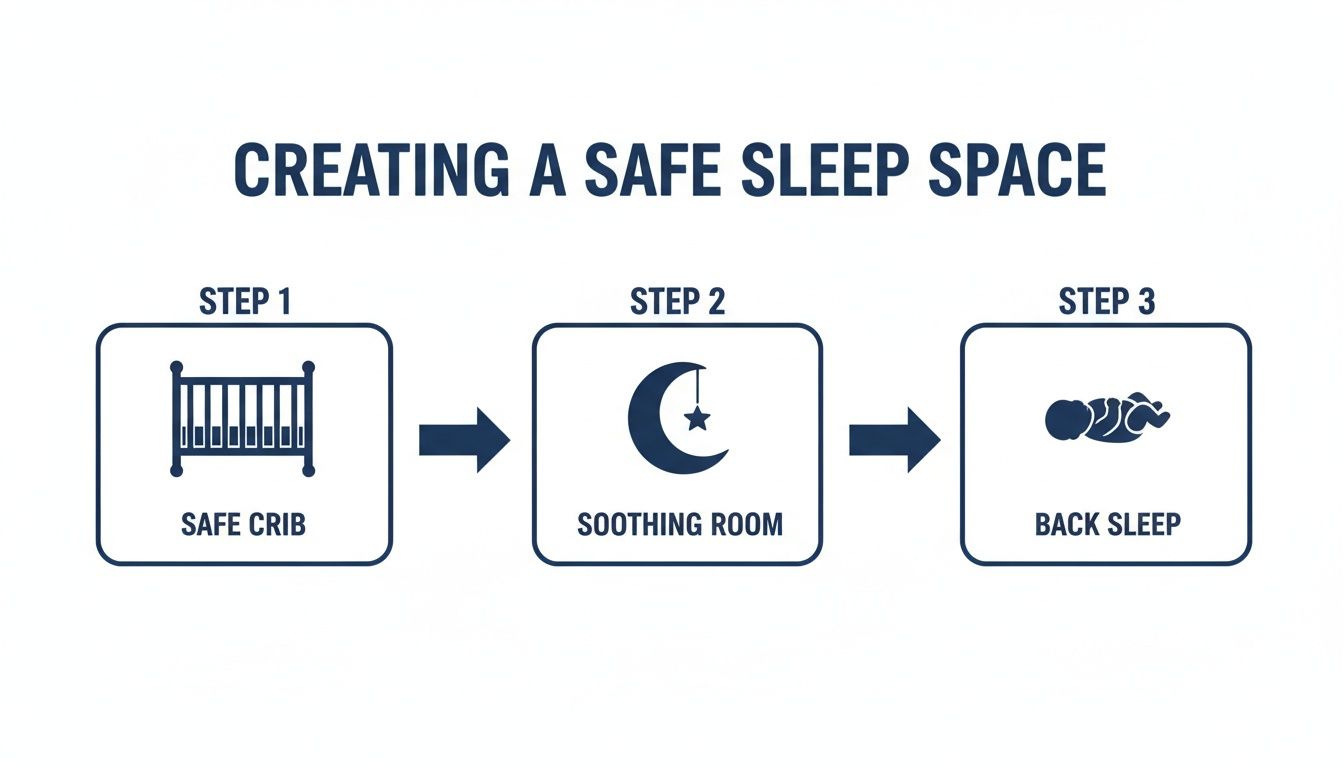
Consistently following these principles builds a foundation of trust and predictability. These principles are a safe cot, a soothing room, and always placing baby on their back to sleep.
A Look at a Typical Day: 0–3 Months
A newborn's day is a repeating loop of short cycles. Wake windows, the amount of time they can comfortably stay awake, are incredibly short. They are often just 60 to 90 minutes. Pushing past this window leads to an overtired, fussy baby who finds it harder to settle.
Here is what a sample flow might look like:
- 7:00 AM: Wake, feed, and have a nappy change.
- 8:15 AM: Spotting some tired signs, so it is back down for a nap.
- 9:45 AM: Baby wakes up and has another full feed.
- 10:15 AM: A little gentle playtime on their mat.
- 11:00 AM: Time to settle for the next nap.
This pattern just keeps repeating all day long. The key isn't the exact time on the clock but the consistent sequence. Naps will vary wildly, from a 20-minute catnap to a solid two-hour stretch, and that’s completely normal.
Australian parenting resources show how much sleep patterns for babies evolve. For babies aged birth to three months, total sleep can range from 14 to 17 hours scattered throughout a 24-hour period.
Typical Newborn Sleep Patterns by Age
As your baby grows, their sleep needs and patterns will naturally change. This table gives you a general idea of what to expect in the first six months.
| Age Range | Total Sleep (24 Hours) | Daytime Naps | Typical Night Sleep |
|---|---|---|---|
| 0–3 Months | 14–17 hours | 3–5 naps | Wakes every 2–4 hours for feeds |
| 3–6 Months | 12–15 hours | 3 naps | May start sleeping a 5-6 hour stretch |
Remember, these are just averages. Every baby is different. Focus on your little one's cues rather than the clock.
Evolving the Routine: 3–6 Months
As you head towards the three-month mark, you will likely notice changes. Your baby’s wake windows will naturally get longer. Their naps might start to become more predictable. Their internal body clock is starting to work, which means you can introduce more structure.
A typical day might begin to look like this:
- 7:00 AM: Wake up, have a good feed, and some playtime.
- 9:00 AM: Down for the first nap of the day. This is often the longest and most restorative one.
- 11:00 AM: Wake up, feed, and enjoy some more interactive play.
- 1:00 PM: Settle in for the second nap.
- 3:00 PM: Wake, feed, and have a short play session.
- 4:30 PM: A quick catnap to bridge the gap until bedtime.
- 6:30 PM: Start a calming bedtime ritual. This could be a warm bath, a final feed, and a quiet story.
- 7:00 PM: Bedtime for the night.
Next steps. Keep watching your baby, not the clock. A flexible routine is your best friend. It gives you a framework that can adapt to growth spurts, teething, and developmental leaps. All while providing the consistency your baby needs to feel secure and build healthy sleep habits.
Mastering Soothing and Settling Techniques

Learning how to calm a fussy baby is a game-changer. It is one of the most powerful skills you can have as a new parent. It turns frantic, tear-filled moments into peaceful ones. It is the heart of building a successful sleep routine.
The real secret is acting on their earliest sleepy signs before they become overtired. You know the look. The little glazed-over stare, a tiny yawn, or rubbing their eyes. These are signals that their wake window is closing. When you spot them, it is time to work your settling magic.
The Power of the 5 S's
A brilliant way to soothe a newborn comes from the ‘5 S’s’ concept. It is about recreating the cosy, familiar sensations of the womb. This method is incredible because it triggers a baby’s calming reflex, a natural off-switch for crying.
Let's break it down:
- Swaddle: A snug swaddle gives them that secure, held feeling and stops their startle reflex from waking them.
- Side or Stomach Position: Holding your baby on their side or stomach is incredibly calming. Just remember to always place them on their back for sleep.
- Shush: Making loud, rhythmic shushing sounds mimics the constant whoosh they heard inside you.
- Swing: Gentle, rhythmic rocking or swinging motions are pure magic for soothing an unsettled baby.
- Suck: Sucking on a dummy, a clean finger, or the breast has a deeply calming effect.
You might not need all five every time. Often, a good swaddle and a gentle rock are all it takes to help your little one drift off.
Reading Your Baby’s Tired Cues
Understanding when your baby is getting sleepy is half the battle. Overtired babies release cortisol, a stress hormone that makes it much harder for them to fall asleep and stay asleep. Catching it early is everything.
Keep an eye out for these classic signs:
- Yawning
- Rubbing their eyes or ears
- A glazed, unfocused stare
- Becoming quiet and still
- Making jerky arm and leg movements
- Fussing, grizzling, or general crankiness
The moment you see these signs is the perfect time to start your wind-down ritual. This is long before the fussiness kicks in.
A consistent, calming pre-sleep ritual is your greatest ally. It doesn't need to be long or complicated. Just a few minutes of predictable, soothing activities can signal to your baby that sleep is approaching.
This simple sequence tells their brain it is time to switch off from the stimulating world and prepare for rest. It creates a powerful sleep association that makes settling so much smoother.
Creating a Simple Pre-Sleep Ritual
A calming ritual helps your baby transition from being awake to the quiet of sleep. Think of it as the cornerstone of any gentle newborn sleep routine.
Here are a few practical ideas you can mix and match to find what works for you:
- A Warm Bath: The gentle warmth is naturally relaxing and is a clear signal that the day is ending.
- A Gentle Massage: Using a baby-safe lotion, gently massage their legs, arms, and tummy. This physical connection is both calming and wonderful for bonding.
- Quiet Stories or Songs: Dim the lights and read a soft-toned story or sing a gentle lullaby. The sound of your voice is one of the most comforting things to them.
- A Final Feed: A calm, quiet feed in a dimly lit room is often the perfect final step before bed.
The specific activities you choose matter less than consistency. By repeating the same few steps in the same order before every sleep, you build a powerful and predictable cue they will quickly learn to recognise.
Beyond swaddling and rocking, understanding the best practices for pacifier introduction and use can be another valuable tool for calming your baby.
The Nuance of Feeding to Sleep
Let's be clear. Feeding your baby to sleep is a natural and beautiful way to help them settle, especially in the early months. It provides comfort, nourishment, and closeness all at once. There is absolutely nothing wrong with it.
However, as your baby gets a bit older, around the four-month mark, it can sometimes become a tricky habit. This happens if it is the only way they know how to fall asleep. If they wake during the night, they might need a feed to get back to sleep, even if they are not hungry.
To gently encourage independent settling skills later, you can try occasionally putting your baby down when they are drowsy but still awake. This gives them a chance to practise drifting off on their own. This is not something to stress about in the first few weeks. Just keep it in mind as a gentle goal for the future.
Troubleshooting Common Newborn Sleep Challenges
Even with the gentlest routine, every new parent hits a few sleep bumps. Your baby's sleep needs are constantly changing. What worked last week might suddenly stop working this week.
This is completely normal. Think of it as part of navigating a newborn baby sleep routine. When things go off track, it is usually down to a few common culprits. The key is to stay curious and flexible rather than feeling like you have failed. By figuring out the root cause, you can make small tweaks that get things back on track.
Common Hurdle: Day and Night Confusion
One of the first challenges many parents face is day-night confusion. This is when your baby sleeps for long stretches during the day, only to become bright-eyed at night. It is a classic sign their internal body clock has not kicked in yet.
To gently guide them, you can use simple environmental cues:
- Embrace Daytime Light: During the day, open the blinds and keep your home bright and filled with normal household sounds. You do not need to tiptoe around a napping baby.
- Create Night-time Darkness: In the evening and for all night sleeps, make their room as dark as possible. A dim, warm-toned nightlight is fine if you need it, but otherwise, think cave-like darkness.
- Keep Nights Boring: Night-time interactions should be all business. Keep your voice low, avoid playful chat, and minimise eye contact. The message is clear: night is for sleeping, not for socialising.
Dealing with Short Naps or ‘Catnapping’
Is your baby only napping for 30 or 45 minutes at a time? This is incredibly common and known as ‘catnapping’. It often happens because they wake up after a single sleep cycle and have not yet learned how to link to the next one.
While it can be frustrating, it is a developmental phase that most babies grow out of.
An overtired baby is often the main cause. A baby who has been awake for too long finds it much harder to settle into a deep, restorative sleep. Pay close attention to their wake windows and sleepy cues. The moment you see that first yawn or glassy stare, it is time to start your wind-down routine.
Remember, a short nap is better than no nap at all. Instead of stressing about the length, focus on providing consistent opportunities for rest. As your baby matures, their ability to connect sleep cycles will improve naturally.
Why Is My Baby Suddenly Waking More at Night?
If your baby’s sleep suddenly goes backwards, a growth spurt could be the reason. These usually happen around 2-3 weeks, 6 weeks, and 3 months. During a spurt, your baby might be hungrier than usual and wake more frequently for feeds. The best approach is to follow their lead, offer extra feeds as needed, and know that it typically only lasts for a few days.
Another common reason for disrupted sleep is the ‘witching hour’. This fussy period, often in the late afternoon or evening, can make settling for the night much harder. For more tips, you can check out our guide on navigating the newborn witching hour.
It is also important to have realistic expectations about night wakings. The Raising Children Network notes that about half of babies aged six to 12 months still wake up once or twice a night.
When to Seek Professional Advice
While most sleep challenges are a normal part of your baby’s development, sometimes you might need extra support. Trust your instincts as a parent.
It is a good idea to chat with a professional if:
- Your baby is consistently difficult to settle and seems to be in pain or discomfort.
- You are concerned about their feeding, weight gain, or the number of wet nappies.
- Your own mental health is suffering due to severe sleep deprivation.
Your local Child Health Nurse or GP is a wonderful first point of call. They can offer reassurance, check for any underlying issues, and provide personalised advice to help you and your baby get the rest you both need.
Common Questions About Newborn Sleep
When you are navigating the hazy world of newborn sleep, it is natural to have questions. You are getting to know a brand-new little person. It is okay to look for reassurance along the way.
Let's dive into some of the most common queries from new parents trying to create a gentle newborn baby sleep routine.
When Should I Actually Start a Sleep Routine?
You can start creating gentle, predictable patterns from the very first few weeks. However, it is important to keep your expectations realistic. A "routine" for a newborn is not about watching the clock.
Think of it more as a rhythm. A simple ‘eat-play-sleep’ cycle is a great place to start. Introduce calming cues that signal sleep is coming, like swaddling, turning on white noise, or darkening the room. A more structured routine usually becomes possible around the three-month mark, once their natural circadian rhythm starts to mature.
The aim isn't to force your baby onto a schedule. It’s about creating a familiar and soothing sequence of events that helps them feel safe and secure, making it easier to drift off to sleep.
Is It Bad to Feed My Baby to Sleep?
Absolutely not. Feeding your baby to sleep is one of the most natural, comforting things you can do in those early months. It combines warmth, nourishment, and closeness. This is a powerful combination for soothing a tiny baby.
As your little one gets older, say around four to six months, you might find that always feeding to sleep can create a strong sleep association. This just means they might struggle to fall asleep or resettle during the night without a feed.
When you feel ready, you can try occasionally putting your baby down when they are drowsy but still awake. This gives them an opportunity to learn how to fall asleep on their own, a skill that will be useful later.
How Can I Keep a Routine When We’re Travelling?
Consistency is great, but when you are away from home, flexibility is your best friend. The goal is to recreate your baby's familiar sleep environment as best you can to give them a sense of security.
Here are a few things that can make a real difference:
- Pack the essentials: Bring their sleep sack or swaddle, a portable white noise machine, and any special comforters. Familiar smells and sounds go a long way.
- Create the right space: A set of travel blackout blinds can be a game-changer, making any room dark and nap-friendly.
- Stick to your rituals: Even if the timing is off, keep your pre-sleep routine. A familiar bath, book, or lullaby sends a powerful signal that it is time to wind down.
Try not to stress if naps are missed or bedtimes are pushed back. Just focus on getting back into your home rhythm once you return.
My Baby Only Naps for 30 Minutes. What Am I Doing Wrong?
Nothing at all! Short naps, or 'catnaps', are incredibly common, especially in the first few months. It usually happens because a baby wakes up after a single sleep cycle, which for them is only about 30-45 minutes long. They just have not figured out how to link their sleep cycles together yet.
First, double-check they are not getting overtired before the nap. Keep an eye on their tired signs and make sure their wake windows are age-appropriate. When they do wake from a short nap, you can try resettling them for 10-15 minutes with some gentle shushing or patting. More often than not, this is a skill that develops with time, usually between four and six months.
At Wallaby Collective, we understand that creating a calm, beautiful space for your little one is part of the journey. Our modern, OEKO-TEX certified linen play mats provide a soft, safe surface perfect for tummy time, play, and those precious quiet moments. Discover our collection of quilted play mats.
Sources:
- Newborn sleep, Raising Children Network, 18 December 2022
- Safe sleeping, Red Nose Australia, 21 February 2024