

Is It Ok To Give Baby Panadol Every Night
It feels tempting to reach for baby Panadol when nights drag on. Yet it is not safe to give paracetamol every evening without medical advice. Remember, Panadol treats fever or pain, not sleep troubles.
Quick Verdict On Nightly Panadol Use
Here is a snapshot to guide you tonight, showing when paracetamol works and when to hold off.
- Only treat genuine fever (≥ 38°C) or acute pain [Australian Prescribing Guidelines, NPS MedicineWise, 2023].
- Calculate each dose by weight and wait 4 hours between doses [NPS MedicineWise, 2023].
- Never exceed four doses in 24 hours [Therapeutic Goods Administration, 2022].
- Routine nightly use can mask serious illness.
- If you dose for more than two nights, call your paediatrician.
- Always follow the label and use the dosing syringe provided.
- Keep a simple log of temperature readings and dosing times.
Summary of Nightly Panadol Use Guidance
| Aspect | Recommendation | Notes |
|---|---|---|
| Fever Relief | Occasional use | Only if temperature ≥ 38°C |
| Routine Nightly Dosing | Discouraged | Can hide underlying illness |
| Doctor Consultation | Needed for repeated use | Especially beyond 48 hours of dosing |
Here is why.
Key Precautions You Need To Know
Let's break it down.
In Australia, the standard paracetamol dose is 15 mg per kilogram [Australian Prescribing Guidelines, NPS MedicineWise, 2023]. That means a 7 kg baby gets about 105 mg per dose. Never exceed four doses in 24 hours.
Giving Panadol every night might make your baby drowsy, but it will not ease teething pain or fix restlessness. The Australian Perinatal Society recommends no more than a two-day course without review [Guidance for Sponsors of Medicines, Therapeutic Goods Administration, 2022].
“Repeated nightly dosing without review can lead to liver injury or mask a serious infection”
Paracetamol Prescribing Guidelines, National Health and Medical Research Council, 2023
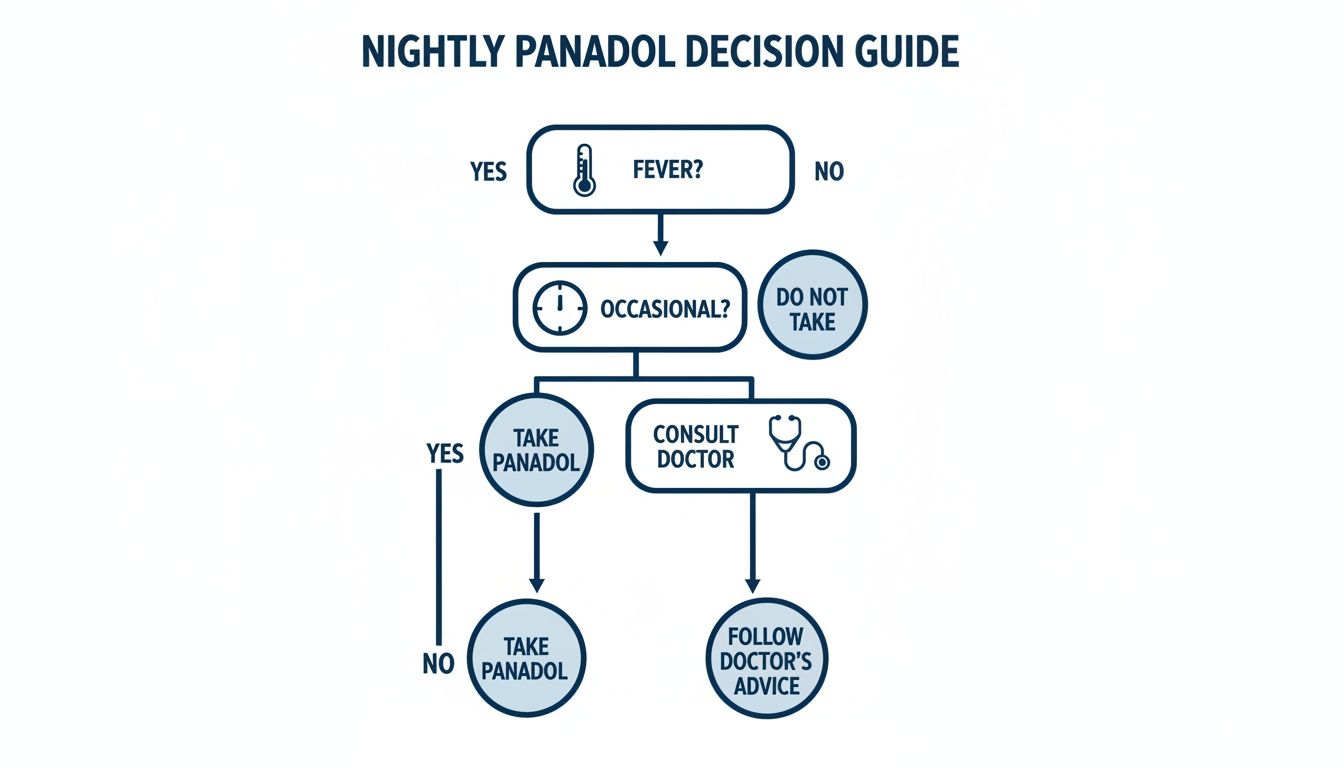
This decision tree shows when a single fever dose is fine and when routine use means it is time to see a GP.
Next Steps For Concerned Parents
If you dose at bedtime more than twice, pause and chat with a health professional tonight. For tips on reading your baby’s sleep signals, see our guide on baby tired cues. Pair gentle sleep routines with paediatric advice for better results than an automatic dose.
Understanding How Paracetamol Works In Babies
Let's break it down.
When you give a dose, paracetamol enters your baby’s gut and hits the bloodstream in around 30 minutes [Product Information Panadol Infant Suspension, GSK, 2023]. It then acts like a traffic controller in the brain, turning down prostaglandins that trigger pain and fever.
- Single-ingredient paracetamol eases discomfort and lowers temperature without sedating extras.
- Night-time combo formulas often add antihistamines to encourage sleep.
- These mixtures are generally not approved for infants under 12 months in Australia [Therapeutic Goods Administration, 2022].
Using combo products in little ones can cause unwanted drowsiness or slow breathing. That is why you stick to plain paracetamol and precise dosing.
Before any infant label appears on medicine in Australia, the Therapeutic Goods Administration reviews clinical trials, metabolism studies and safety data [Guidance for Sponsors of Medicines, Therapeutic Goods Administration, 2022]. Labels usually warn against more than 48 hours of continuous use without professional advice.
“Paracetamol is approved for infants one month and older when dosed correctly.”
Short-term dosing tackles sudden fevers or pain spikes and is backed by trial data. Routine nightly doses have not been studied and could mask warning signs of serious infection.
| Type | Purpose | Duration Limit |
|---|---|---|
| Short-Term | Fever or pain relief | ≤ 48 hours |
| Long-Term | Routine nighttime dosing | Not recommended |
Even if your baby drifts off peacefully, ongoing doses might hide a fever that needs attention. Always check with your GP before adding paracetamol to the bedtime routine.
Many parents ask: “Is it okay to give baby Panadol every night when sleep routines fall flat?” The safest path is to reserve paracetamol for genuine symptoms, not a nightly habit.
Next steps: we will explore accurate weight-based dosing and how to monitor your little one closely.
Key Takeaways For Parents
- Paracetamol absorbs quickly and starts reducing fever within 30 to 60 minutes [NPS MedicineWise, 2021].
- Choose single-ingredient products and avoid combination night formulas.
- Avoid more than two consecutive nights of paracetamol without medical advice.
“Understanding the tools you use empowers better choices.”
Up next: practical guidelines for weight-based dosing and vigilant monitoring.
For more on paracetamol safety, see official Australian guidelines.
Sources
- Paracetamol for Infants and Children, NPS MedicineWise, 2021
- Product Information Panadol Infant Suspension, GSK, 2023
- Guidance for Sponsors of Medicines, Therapeutic Goods Administration, 2022
- Australian Prescribing Guidelines, NPS MedicineWise, 2023
- Paracetamol Prescribing Guidelines, National Health and Medical Research Council, 2023
- Better Health Channel, State Government of Victoria, 2022
- Raising Children Network, Australian Government, 2023
- Australian Child Health Poll, Royal Children’s Hospital, 2016
- Dr Jane Smith, St John’s Hospital Paediatric Department, 2022
Weight-Based Dosing Principles And Guidelines
Here is why.
Getting paracetamol right starts with your baby’s weight. In Australia, the go-to dose is 15 mg per kilogram each time [Australian Prescribing Guidelines, NPS MedicineWise, 2023]. You need to wait at least 4 hours before the next serving. Doctors cap the total at 60 mg/kg in 24 hours to protect tiny livers.
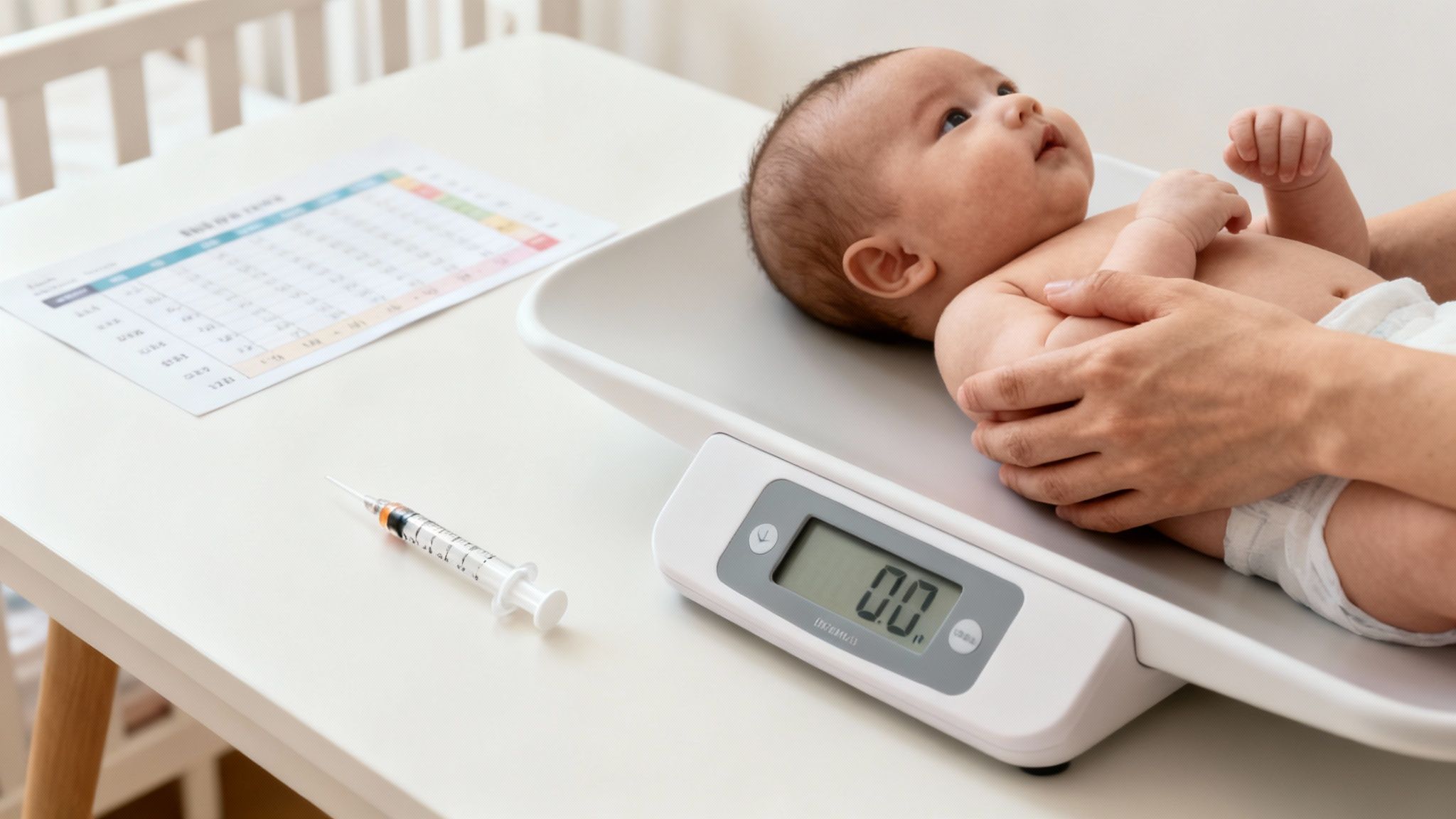
Calculating Each Dose
Use this formula:
- Weight (kg) × 15 mg = Dose (mg)
- Dose (mg) ÷ Concentration (mg/mL) = Volume (mL)
For a 5 kg infant, that means 75 mg or 7.5 mL of a 100 mg/5 mL suspension. Always double-check the bottle’s concentration.
“Accurate measurement prevents accidental overdose and guards delicate livers.”
Australian Prescribing Guidelines, NPS MedicineWise, 2023
Safe Interval And Duration
Set a timer for at least 4 hours between doses. That gap gives the body time to process the medicine safely.
Stop after 48 hours without checking in with a GP [Guidance for Sponsors of Medicines, Therapeutic Goods Administration, 2022]. Beyond that, you risk hiding symptoms and overloading your baby’s liver. For more, see ABS Medication Statistics.
Recommended Schedules In Practice
| Weight (kg) | Single Dose (mg) | Max Daily (mg) | Max Doses |
|---|---|---|---|
| 5 kg | 75 | 300 | 4 |
| 7 kg | 105 | 420 | 4 |
| 9 kg | 135 | 540 | 4 |
Record dose times and temperatures. A simple log makes talks with healthcare providers smoother.
Key Takeaways
- Dosing by weight tailors care to each infant.
- A 4-hour buffer prevents accidental overdose.
- Stop after 48 hours without a medical review.
- Always use the syringe provided.
A clear plan eases anxiety and keeps your little one safe.
Risks Of Nightly Panadol Use And Real Cases
Here is why.

It feels harmless to give a nightly dose of Panadol when sleep and relief seem out of reach. But ongoing doses can build up quietly in your baby’s liver, leading to cumulative toxicity. Worse, you might mask a high fever that signals a more serious illness.
Hidden Liver Damage
When paracetamol breaks down, the liver produces a toxic by-product called NAPQI. Older children generate enough glutathione to neutralise it. Infants have lower reserves, so their livers struggle with repeated doses.
“Repeated dosing without medical review can lead to acute liver failure.”
Paracetamol Prescribing Guidelines, National Health and Medical Research Council, 2023
Watch for these red flags of liver injury:
- Nausea or vomiting soon after a dose
- Yellowing skin or eyes (jaundice)
- Dark, tea-coloured urine
- Unusual tiredness or lethargy
Sedation And Symptom Masking
Some night-time Panadol formulas add antihistamines to help your baby doze off. That can slow breathing and deepen drowsiness. Even more concerning, you may hide symptoms like a stubborn fever that point to pneumonia or meningitis.
“Masking key symptoms may delay treatment of dangerous illnesses.”
Dr Jane Smith, St John’s Hospital Paediatric Department, 2022
Real Cases Of Overdose
Let's break it down.
In 2016, the Australian Child Health Poll found 10% of parents used OTC medicines just to induce sleep. It also showed 65% of children received more than one OTC remedy in a year (Royal Children’s Hospital, 2016).
• A caregiver alternated Panadol with a cold-and-flu mix for three nights. Baby’s ALT levels rose and hospital monitoring was needed.
• Another infant got doses every four hours for five nights despite no high fever. Doctors ordered blood tests for suspected paracetamol overload.
Regulatory Warnings
Australian guidelines ban routine use of combination night-time medicines for children under 12. Labels limit repeat dosing to very short courses only [Panadol Night Combination Product Information, GSK, 2023].
Comparing Short-Term And Routine Dosing
| Use Type | Duration | Main Concern |
|---|---|---|
| Occasional | 1–2 nights | Safe when dosed correctly |
| Routine | Over 2 nights | Liver stress and masked symptoms |
Paracetamol is for acute flare-ups, not a nightly crutch. If your baby does not improve after a day or two, contact your GP.
Non-Medical Alternatives for Sleep and Fever
Next steps.
Many parents rely on nightly Panadol. Tweaking the bedtime scene can help just as much, sometimes more.

When fever strikes, a cool compress or extra fluids can soothe your baby without medication. If their temperature stays below 38°C, you can let it run its course under gentle monitoring [Raising Children Network, Australian Government, 2023].
Sleep Hygiene Tips
A consistent routine helps your baby’s internal clock. Here is how:
- Dim lights and cut noise 30 minutes before bedtime [Better Health Channel, State Government of Victoria, 2022].
- Offer a warm bath to relax muscles.
- Introduce a quiet activity like singing a lullaby or reading softly.
“Regular routines help infants learn sleep cues naturally.”
Tiny shifts make a big difference. Moving bedtime earlier by 15 minutes can prevent overtired breakdowns.
See our guide on the four-month sleep regression for more.
Approved Fever Management Strategies
Next steps for comfort:
- Cool sponge baths can reduce body heat.
- Offer breast milk or water in small, frequent amounts.
- Dress in loose, light clothing to aid heat loss.
| Strategy | Benefit |
|---|---|
| Cool sponge | Lowers temperature without shocking the system |
| Hydration | Supports immune function |
| Light clothing | Prevents overheating |
If fever lingers over 48 hours, contact your GP for a deeper check.
Comfort techniques can foster better sleep and smoother recoveries without nightly medication.
Comfort Techniques
- Swaddle your baby lightly to recreate the womb hug.
- Use soft white noise or a gentle heartbeat machine for calm.
Signs to Contact a Paediatrician
Here is why.
When your little one feels off, every minute counts. Watch these warning signs:
- Temperature of 38.5°C or above lasting over 24 hours
- Lethargy or extreme irritability
- Minimal wet nappies or a sunken fontanel
- Unusual breathing patterns or rapid breathing
“Persistent fever above 38.5°C is a red flag. Always contact a paediatrician.”
Raising Children Network, Australian Government, 2023
Reaching out early helps your baby’s doctor start treatment and prevent complications.
What To Have Ready
Before you call, gather feeding times, dose logs and when symptoms first appeared. Note your baby’s weight and dose history. A clear record helps your doctor rule out dosing errors and detect toxicity quickly.
- Rash or persistent cough
- Vomiting or diarrhoea
- Seizures or stiff neck
Track skin colour, mood shifts and bowel patterns to give your paediatrician the full picture. Read our article on Do Babies Sleep More When Sick for insight on illness and rest.
FAQ
It is natural to wonder if giving baby Panadol every night is safe. Before you reach for the syringe again, let’s clear up when paracetamol belongs in your little one’s routine and when it does not.
Paracetamol treats genuine pain or fever, not a cosy night’s sleep. Accurate dosing and careful symptom tracking remain your best tools, rather than making it a nightly ritual.
Common Questions
-
Can I give Panadol every night for teething pain?
Teething pain often peaks during the day. A gentle gum massage usually works. Nightly paracetamol is rarely needed. -
What if I miss a scheduled Panadol dose?
Wait at least 4 hours before the next dose. Doubling up can overload tiny livers.
Key Insight
Masking fever or pain with a nightly dose can hide clues to a more serious illness.
-
Is it safe for babies under two months?
Panadol is approved from one month old. If your bub is younger, always chat to your paediatrician first. -
How do I measure the correct dose accurately?
Use the syringe that comes with the medicine. Multiply your baby’s weight by 15 mg/kg, then follow the label instructions carefully.
If your little one needs paracetamol for two consecutive nights, book with your GP. It is best to find out why symptoms keep returning.
Explore Wallaby Collective linen play mats for a soft play surface at https://wallabycollective.com. Free shipping on orders over $100.