

Educational Gifts for Toddlers That Spark Learning
Choosing the right educational gifts for toddlers is about more than just keeping them busy. It is about finding special toys that are fun and genuinely support their development. Think less about flashy, noisy gadgets and more about gifts that spark imagination, encourage problem-solving, and get them actively involved. A thoughtful choice invests in their future.
Why Educational Gifts Matter for Toddler Development
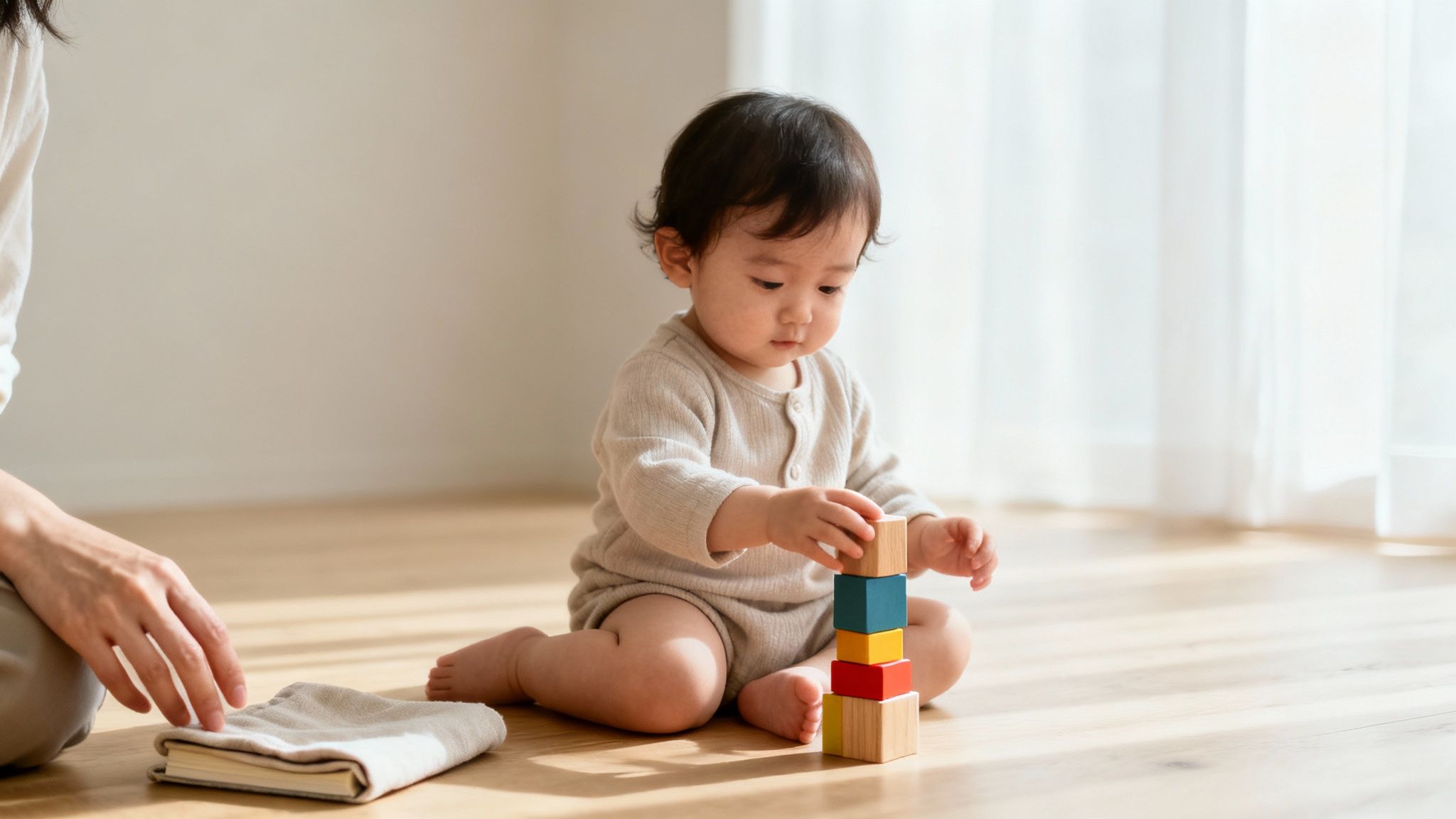
Giving a gift to a toddler is a beautiful opportunity to nurture their incredible, rapidly growing mind. During these early years, every interaction is a chance to learn something new. Purposeful play is not just a distraction; it is the main way they figure out the world around them.
Let's break it down. When a toddler stacks blocks, they do more than just make a tower. They get a hands-on lesson in gravity, figure out spatial awareness, and refine fine motor skills. This kind of active engagement is worlds away from passive screen time.
The Connection Between Play and Learning
Here in Australia, we have seen a real shift in how parents think about toys. This shift lines up with the growing number of children in early education. A recent report showed that over 1.4 million children were enrolled in government-approved child care services. This shows how much mums and dads value early learning.
This trend highlights that parents want toys and resources that feel like a natural extension of what their little ones learn at preschool or day care. They want gifts that are both a delight to play with and genuinely beneficial.
Fostering Key Developmental Milestones
Educational gifts are brilliant tools for helping toddlers reach key developmental milestones. They offer tangible, hands-on ways for them to practise and master new skills.
Here is why they are so effective:
- Cognitive Growth: Puzzles, memory games, and shape sorters are fantastic for building problem-solving abilities and logical thinking.
- Motor Skills: Simple activities like threading beads or drawing with chunky crayons improve fine motor control. This skill is important for learning to write later.
- Language Acquisition: Picture books and puppets are perfect for encouraging new words and storytelling. In fact, classic books like Brown Bear, Brown Bear, What Do You See? are wonderful for introducing colours and animals in a simple, repetitive way.
When you choose a gift that aligns with a toddler’s developmental stage, you are not just giving a toy. You are offering a carefully chosen tool that supports their personal journey of discovery and growth.
Ultimately, the best educational gifts ignite a child's natural curiosity and help lay the foundations for a lifelong love of learning.
Choosing Gifts for Key Developmental Milestones
Not every educational toy is the right fit for every toddler. It is a bit of a balancing act. A gift that is too advanced can lead to frustration, while one that is too simple might be tossed aside after five minutes. The real secret is to choose educational gifts for toddlers that meet them exactly where they are.
Let's break it down. When you match a gift to what a child is actively learning and exploring, you give them a tool that feels both fun and perfectly challenging. That is the sweet spot where real learning happens.
Gifts for Growing Motor Skills
Toddlers are masters of movement, constantly working on their physical skills. Their development splits into two main areas. The best gifts are the ones that support both.
- Gross Motor Skills: This is all about the big muscle movements like running, jumping, and climbing. Think about gifts like small push-bikes, soft balls for rolling and chasing, or even a spacious, cushioned play mat that creates a safe space for tumbling and crawling.
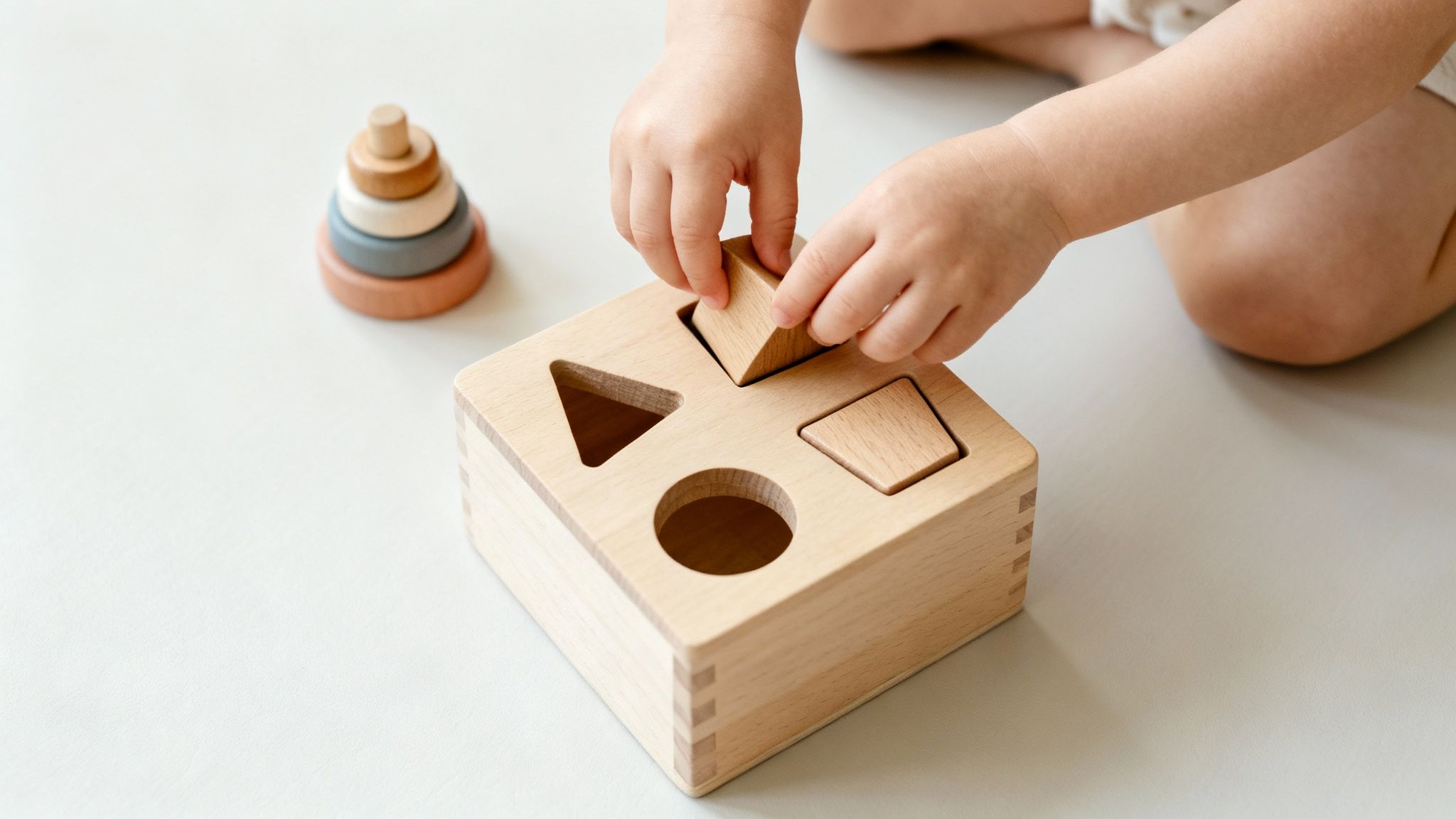
- Fine Motor Skills: This covers all the small, precise movements of the hands and fingers. Stacking blocks are perfect for this, as they build hand-eye coordination and spatial awareness. Chunky threading beads are another great option, requiring focus and dexterity.
A simple shape sorter is a classic for a reason. It gets a toddler using their fine motor skills to grasp the shapes, problem-solving to figure out where each one goes, and hand-eye coordination to post them through the right holes.
The right gift empowers a toddler by giving them that satisfying sense of achievement. When they finally stack that last block or fit a puzzle piece, they are not just playing; they are building confidence and resilience, one small win at a time.
Supporting Cognitive and Language Growth
Beyond just the physical, a toddler’s mind is expanding at an incredible rate. They are soaking up language like little sponges and figuring out how to think critically. Choosing gifts that support this cognitive leap is so important.
Puzzles are fantastic for this stage. They teach patience, shape recognition, and the very basics of logical thinking. To dive deeper into their benefits, you can explore the wonderful world of puzzles for kids in our detailed guide.
This period is vital for getting a child ready for school. Data from the Australian Early Development Census revealed that 22 percent of children start school with developmental vulnerabilities in areas like language or cognitive skills. Thoughtful gifts can play a supportive role in helping to bridge this gap.
Nurturing Social and Emotional Intelligence
Play is how toddlers learn to understand big feelings and interact with others. That is why gifts that encourage imaginative and open-ended play are essential for building social and emotional intelligence.
Think simple. Dress-up items like a cape or a hat can transform a child into any character they dream up. A versatile, neutral play mat creates a dedicated stage for all kinds of imaginative scenarios, whether it is a teddy bears' picnic or a bustling city made of blocks.
These simple tools give toddlers the freedom to explore different roles, express their feelings, and develop empathy. They will carry these skills with them for life.
How to Assess Toy Safety and Quality Standards
When you choose educational gifts for toddlers, nothing matters more than safety. A toy might look bright and engaging on the shelf. But the things you cannot immediately see, like its materials or construction quality, are truly important.
A toddler’s world is completely hands-on. This means every gift will be touched, chewed, and thoroughly explored. This is why you must insist on well-made, non-toxic products.
In Australia, all children's toys must meet mandatory safety standards. These rules exist to protect our little ones from common hazards. But it is still smart for parents and gift-givers to know what to look for. Being an informed shopper gives you the confidence to choose gifts that are safe, durable, and genuinely good for the child.
Decoding Australian Safety Labels
The first place to look is the packaging. Keep an eye out for compliance with the mandatory Australian standard, AS/NZS ISO 8124. This is your assurance that the toy has been properly tested for safety.
This standard covers potential dangers like small parts that could be a choking hazard, sharp edges, and the presence of toxic elements like lead or mercury.
Another critical piece of information is the age-grading label. This is not just a suggestion about a child's cognitive ability; it is a vital safety guideline. A toy labelled "Not suitable for children under 3 years" often means it contains small parts that pose a serious choking risk for toddlers. Always respect these warnings.
A Practical Safety Checklist
Beyond the official labels, a quick physical inspection can tell you a lot about a toy's quality and safety. Before you buy, or once you have unwrapped the gift, run through this simple checklist.
- Check for Small Parts: Can any little pieces detach easily? The Australian Competition and Consumer Commission advises using a 3.2 cm diameter cylinder to test for choking hazards for children under three.
- Inspect the Construction: Is the toy well-made? Look for sturdy seams on plush toys, splinter-free finishes on wooden items, and durable plastic that will not shatter into sharp pieces.
- Examine Strings and Cords: Any cords or strings on pull-along toys should be short enough that they cannot pose a strangulation risk.
- Ensure Non-Toxic Materials: Check that paints and finishes are explicitly labelled as non-toxic. High-quality brands will usually state this clearly on their packaging.
Investing in high-quality materials is always a smart choice. Natural materials like solid wood, organic cotton, or OEKO-TEX certified linen are not only safer but are also far more durable. They are free from harmful chemicals and built to withstand years of enthusiastic play.
Ultimately, choosing safe educational gifts for toddlers comes down to careful observation and putting quality first. By checking for safety standards and giving each toy a quick assessment, you can make a confident choice that provides both peace of mind and hours of joyful, safe play.
Sources:
- Child Care in Australia, Australian Government Department of Education, 2023.
- Australian Early Development Census National Report 2021, Australian Early Development Census, 2022.
- Mandatory safety standard for toys for children up to and including 36 months of age, Australian Competition and Consumer Commission, 05 September 2023.
- Choke check tool, Australian Competition and Consumer Commission, 2022.
It is easy to get caught up in the excitement of puzzles and blocks. But sometimes the most powerful learning tools create a foundation for all kinds of play. A high-quality, neutral play mat is one of the most versatile gifts you can give a toddler. It instantly transforms any patch of floor into a dedicated space for discovery.
Let's break that down. Unlike busy, brightly patterned mats that can be overstimulating, a simple, uncluttered surface allows a child’s own creativity to shine. It becomes a blank canvas for their imagination, letting their toys and games take centre stage.
Creating a Defined Space for Play
A play mat naturally sets a boundary for activity. This simple visual cue helps a toddler understand that this is their special area for play. This can make tidying up a little easier and helps keep the toy chaos contained to one part of a room.
For a little one, this defined space offers a sense of security and ownership. It is their world to control, whether they are building a towering city with blocks, lining up their favourite animals for a parade, or just enjoying some quiet time with a book.
A dedicated play space does more than just contain the mess. It provides a consistent and safe environment where a toddler feels free to explore, experiment, and learn at their own pace.
Supporting Physical and Cognitive Development
A good play mat is also a fundamental tool for supporting a toddler’s physical growth. It offers a soft, cushioned surface that is perfect for the tumbles and movements central to developing gross motor skills. From their first wobbly steps to confident crawling and rolling, the mat provides a safe base for it all.
Here is why a simple mat works so well:
- Encourages Movement: It gives them the freedom to practise sitting up, crawling, and eventually walking without the hardness of a wooden floor.
- Promotes Open-Ended Play: A neutral background lets other educational toys, like puzzles and shape sorters, stand out. This reduces distraction and can help improve focus.
- Fosters Imagination: The mat can become anything, an island, a stage, or a picnic spot, letting their creativity lead the way.
The material of the mat is also crucial for both comfort and safety. Natural fabrics like linen are often a great choice as they are gentle on sensitive skin and incredibly durable. If you are weighing up your options, you can compare different play mat materials like linen and foam to see what best suits your family’s needs. By providing this simple, foundational item, you are giving a gift that supports nearly every part of a toddler's early learning journey.
Finding Gifts That Offer Long-Term Value
A great educational gift should feel like an investment, not just a passing novelty. The goal is to choose items that grow with a child, offering long-term engagement and value. Let's break down how to balance your budget with quality and longevity, ensuring your gift remains a favourite long after it is unwrapped.
The key is focusing on open-ended toys. These are items like building blocks, art supplies, or a simple play mat that can be used in countless ways as a child's imagination and skills develop. They do not have a single, fixed purpose, which is exactly why they stay interesting for years.
This approach makes economic sense, too. Investing in durable, multi-purpose items reduces clutter and provides much better value over time than a collection of single-use toys. As the demand for quality educational resources grows, parents are increasingly looking for gifts that last.
In fact, the Australian Preschool Education industry has grown into a $3.9 billion market, partly driven by an increasing number of preschool-aged children. This growth highlights the rising demand for high-quality educational resources that offer real, lasting value. You can find more details in this industry analysis on preschool education in Australia.
The Power of Open-Ended Play
Open-ended toys are the champions of long-term value because they put the child in the driver's seat. Instead of the toy dictating the play, the child's creativity directs the action.
Magnetic tiles, for example, can be a flat pattern for a two-year-old and a complex three-dimensional castle for a four-year-old. This adaptability is what gives them staying power. To see just how versatile these can be, you can explore the benefits of magnetic tiles in open-ended play and discover new ways to spark creativity.
This infographic shows how a simple item like a play mat supports multiple areas of development, making it a powerful open-ended tool.
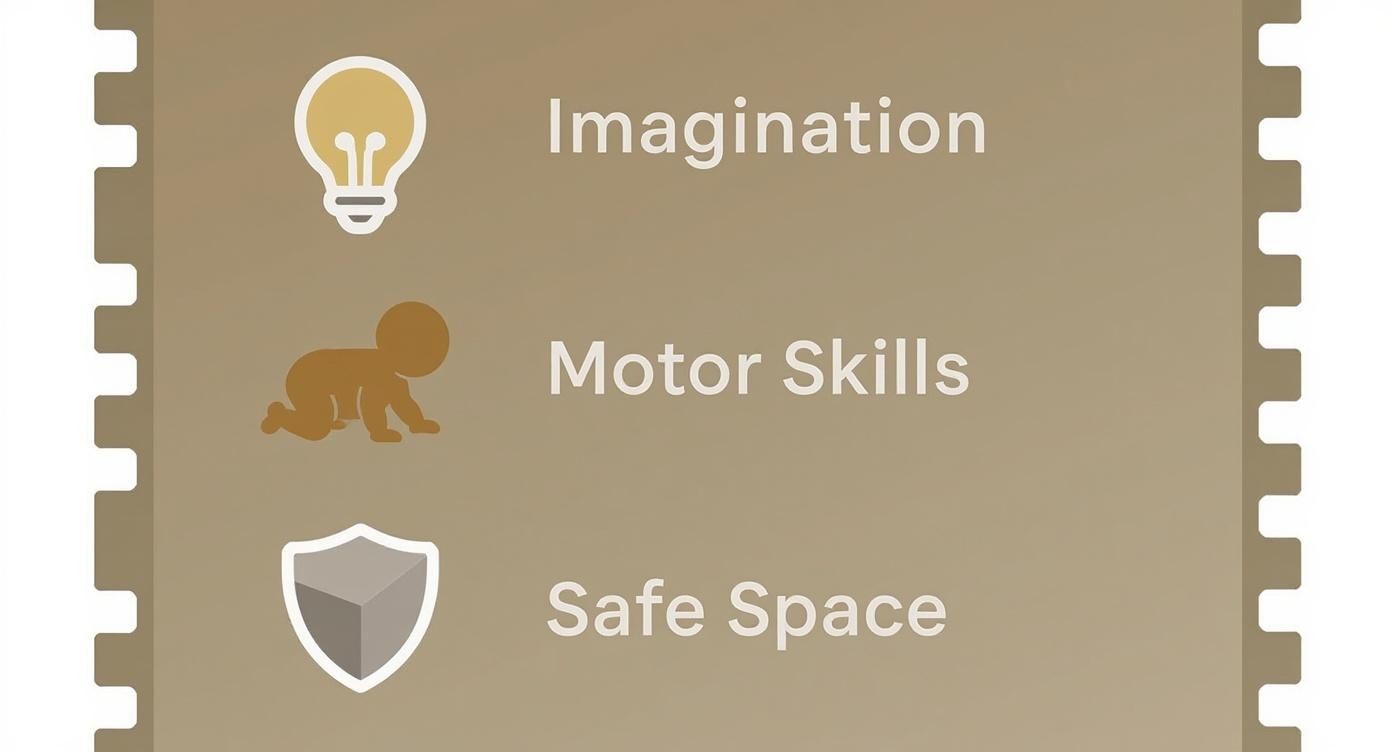
The visualisation highlights that a foundational item provides a safe space while encouraging both imagination and motor skills, proving its long-term utility.
Comparing Open-Ended vs Closed-Ended Toys
Understanding the long-term play value of different types of toddler gifts can be a game-changer. Here is a quick comparison to help you spot the difference between a toy that lasts a few minutes and one that lasts for years.
| Feature | Open-Ended Toys (e.g., Blocks, Play Mat) | Closed-Ended Toys (e.g., Electronic Button Toy) |
|---|---|---|
| Play Possibilities | Infinite; limited only by imagination. | One or two specific functions. |
| Skill Development | Promotes creativity, problem-solving, motor skills. | Teaches a single, repetitive skill (e.g., cause-and-effect). |
| Longevity | Grows with the child, used differently at each stage. | Quickly outgrown once the function is mastered. |
| Child's Role | Active creator and director of play. | Passive participant, follows the toy's lead. |
| Value Over Time | High; used for years in various ways. | Low; novelty wears off quickly. |
The takeaway is clear. While a flashing, singing toy might grab a toddler's attention initially, the simple, versatile items will truly stand the test of time, becoming beloved staples of the playroom.
Choosing open-ended educational gifts for toddlers is about prioritising potential over prescription. It is about giving a child a set of tools, not a finished product, empowering them to become the creators of their own play. This approach not only stretches your budget but also nurtures the skills that matter most, like problem-solving, creativity, and independent thinking.
Answering Your Top Questions About Educational Toddler Gifts
Choosing a gift for a toddler can feel surprisingly tricky. You want something they will love, but you also want it to be safe, high-quality, and genuinely good for their development. If you have found yourself puzzling over the options, you are not alone.
To help you feel confident in your choice, let’s clear up some of the most common questions that pop up for parents, aunties, and friends.
What Makes a Gift Truly Educational?
A gift becomes educational when it helps a toddler learn and grow. But that does not just mean flashcards or talking toys. A truly great educational gift is one that gets them actively involved, sparking their natural curiosity and encouraging them to do something, rather than just watch.
Think of it this way. A simple puzzle gets their little minds working on problem-solving. Threading big wooden beads helps refine those tiny hand movements (fine motor skills). A balance bike builds coordination and confidence, while puppets can be a wonderful way to explore big feelings and storytelling.
The best educational gifts are invitations to play. They encourage hands-on discovery and let a child learn by doing. This is the most natural way for them to make sense of their world.
For a fantastic deep dive into different options, this ultimate gift guide for toddlers is packed with brilliant ideas.
Are Expensive Electronic Toys Better?
Honestly? Not usually. While some electronic toys are marketed as educational, many are closed-ended. This means they do one or two specific things, which can actually limit a child's imagination. Often, the simplest, most classic toys are the most powerful.
Think about open-ended toys like a set of wooden blocks, some colourful playdough, or even a beautiful, versatile play mat. These items are pure fuel for imagination because a child can use them in a million different ways, and they will grow with them. The real value is in how a toy engages a child’s creativity, not its price tag or how many sounds it makes.
How Do I Choose an Age-Appropriate Gift?
This is so important, both for safety and for making sure the gift is actually fun and not frustrating.
Here is a simple way to think about it:
- Always Check the Label: Start with the manufacturer's age recommendation. It is a crucial safety check, especially for avoiding small parts that are choking hazards for kids under three.
- Think About Their Current Stage: Where is this particular toddler at? Younger toddlers (1-2 years) are all about sensory exploration and big movements. Stacking rings, simple push-along toys, and textured balls are perfect.
- Give Them a Gentle Challenge: For older toddlers (2-3 years), you can introduce things that stretch their skills a little. Think shape sorters, simple 3-4 piece puzzles, or a set of chunky, easy-to-grip crayons for their first masterpieces.
What Are Some Good Non-Toy Educational Gifts?
Educational gifts do not have to be toys at all. Sometimes the most valuable presents are experiences or practical items that create opportunities for learning and making memories.
A few wonderful non-toy ideas include:
- Memberships and Passes: A pass to the local zoo, children's museum, or a nearby play centre is a gift that keeps on giving. It is an invitation for adventure and learning all year round.
- Art Supplies: A big bundle of supplies like chunky crayons, washable paints, and giant pads of paper is fantastic. It encourages creativity, self-expression, and fine motor control.
- Books, Books, Books: You can never go wrong with a good book. Board books are brilliant for building language, introducing new ideas, and fostering a lifelong love of reading.
These kinds of gifts offer rich learning experiences that last far longer than a single playtime, making them an incredibly thoughtful choice.
For a gift that is both beautiful and fundamentally educational, explore the range of neutral linen play mats from Wallaby Collective. Our mats provide the perfect, uncluttered space for a toddler's imagination to flourish, supporting everything from tummy time to imaginative play. Discover the collection at https://wallabycollective.com.