

Best Tummy time toys for safe, engaging baby play
The right tummy time toys are always the ones that click with your baby’s current stage. Think high-contrast cards for newborns and sensory water mats for older babies ready for more action. Good toys do not just distract. They make tummy time engaging and help your little one build strength for big milestones like rolling, sitting, and crawling.
Understanding why tummy time is so important
We all hear how essential tummy time is, but what is really going on during these floor sessions? Think of it as your baby’s first workout. It is a simple, supervised play session on their tummy that builds the foundation for a lifetime of movement.
Here is why. Tummy time directly targets the muscles your baby needs to grow strong.
- Neck and shoulder strength: Lifting that sweet little head against gravity is hard work. This effort strengthens neck and shoulder muscles, which is vital for good head control.
- Core and back muscles: When your baby pushes up on their arms, they fire up their entire core, back, and arm muscles. This is the groundwork for all the bigger movements to come.
- Gross motor skills: This simple routine is the starting block for those major milestones we all look forward to. The strength they build here is what allows them to eventually roll over, sit up on their own, and crawl across the living room.
Promoting healthy physical development
Beyond building muscle, tummy time is a big deal for healthy physical development. Making it a regular part of your day helps prevent conditions like positional plagiocephaly, or flat head syndrome. It simply gives the back of their head a break. If you want to dive deeper, we have a full guide on the benefits of tummy time for babies.
Tummy time is not just a physical workout. It is a sensory one, too. As babies feel the mat beneath them and reach for toys, they learn about body awareness, how to shift their weight, and how to coordinate their movements.
The right start for success
A positive tummy time experience starts with the right setup. The surface you use is just as important as the toys. You need something soft enough for comfort but firm enough for them to push up against. A dedicated play mat is perfect for this. It gives them a safe, stable foundation that a soft bed or plush blanket cannot offer.
Let's break down why the surface really matters.
| Surface Type | Tummy Time Effectiveness | Safety Consideration |
|---|---|---|
| Firm Play Mat | Excellent. Gives your baby the stable support they need to push up and lift their head. | High. A flat, firm surface reduces any suffocation risk. |
| Plush Blanket | Poor. Can make it tricky for a baby to push up; their face might sink in. | Moderate. Puffy materials can pose a suffocation hazard. |
| Bed or Sofa | Not Recommended. Soft, uneven surfaces get in the way of muscle work and are unsafe. | Low. There's a high risk of falls and suffocation. |
This foundation really sets the stage for a successful session. Once you have your space set up, the next step is choosing toys that will keep your little one engaged and motivated.
Choosing the right toys for each developmental stage
As your baby grows, so do their needs for play. The right tummy time toy is the one that meets them where they are right now. It keeps them curious and happy to push up. When you match the toy to their developmental stage, tummy time feels less like a chore and more like a discovery.
Let's break down what your little one is working on at each stage and which toys help them get there. Think of this as a simple roadmap to choosing toys that perfectly align with their next big milestone.
Newborns (0–2 months): All about vision
For the first couple of months, your baby's world is a beautiful blur. Their vision is still developing. They see best in high-contrast colours like black, white, and red. They can only focus on things about 20 to 30 centimetres away. This is roughly the distance from your arms to your face when you hold them close. The main goal here is to stimulate their budding eyesight and encourage those first little head lifts.
Here is why high-contrast toys work so well.
- High-contrast flash cards: Simple black-and-white patterns are captivating for a newborn. You can prop them up nearby to encourage them to focus and turn their head.
- Unbreakable floor mirrors: A baby-safe mirror is easily one of the best tummy time toys for this age. Babies are fascinated by reflections, especially their own. It motivates them to lift their head for a better look.
A key milestone for a 1 to 2-month-old is lifting their head to a 45-degree angle, even if it is just for a moment. A captivating mirror or a striking high-contrast card gives them the perfect reason to try.
Younger infants (2–4 months): Encouraging reaching
Around the two to four-month mark, you will notice your baby’s head control getting much stronger. They start to push up on their forearms. Their little hands become the most interesting things in the world. This is when they start reaching for things on purpose. It is a huge step in developing hand-eye coordination.
Toys that encourage this new skill are your best bet. Look for things that are easy to grasp and offer a satisfying sound or feel when they make contact.
- Tactile sensory balls: Lightweight balls with interesting textures are perfect for small hands just learning to grip. They introduce your baby to different surfaces and help them practise holding on.
- Soft crinkle books: A soft book with crinkly pages offers both sound and touch stimulation. That crackling noise teaches a simple lesson in cause and effect. It encourages them to reach out and explore again and again.
This is also a great time to introduce toys that need a little more interaction. As their head and neck strength improves, they can stay in tummy time for longer. This gives them more time to engage with their surroundings.
Older babies (4–6+ months): Mastering motor skills
By four months, your baby is probably becoming a bit of a tummy time pro. They can likely push up onto their hands, pivot their body to look around, and might even be on the verge of rolling over. Now is the time to introduce more interactive toys that support these bigger movements and feed their growing curiosity.
At this stage, your baby is practising shifting their weight from one arm to the other. This is a foundational skill for crawling. The best toys will challenge them to reach, pivot, and interact in more complex ways.
- Activity gyms: An activity gym with dangling toys is brilliant for encouraging your baby to reach up and bat at things. This simple action strengthens their arms, shoulders, and core muscles all at once.
- Water play mats: These are fantastic for older babies. The squishy water and floating sea creatures inside encourage them to push up and press down. This builds arm strength while teaching them more about cause and effect.
Choosing toys that grow with your baby keeps them challenged and entertained. It turns tummy time into a positive and productive part of their day.
To make things even simpler, here is a quick guide to help you choose the right toy for your baby's age and stage.
Age-appropriate tummy time toy guide
This table provides a quick reference for selecting the best tummy time toys based on your baby's developmental stage, from newborn to six months and beyond.
| Age Group | Developmental Focus | Recommended Toy Types | Why It Works |
|---|---|---|---|
| 0-2 Months | Developing vision, neck strength | High-contrast cards, unbreakable mirrors | Bold patterns and reflections capture their attention, motivating them to lift and turn their head. |
| 2-4 Months | Reaching, grasping, hand-eye coordination | Soft crinkle books, tactile balls, rattles | Easy-to-grasp toys with sensory feedback teach cause and effect, encouraging intentional movement. |
| 4-6+ Months | Pushing up, pivoting, pre-crawling skills | Activity gyms with dangling toys, water play mats | Interactive toys promote reaching, weight-shifting, and core strength, preparing them for mobility. |
Remember, these are just guidelines. Every baby develops at their own pace. The most important thing is to observe what captures your little one's interest and go from there. Happy playing.
Comparing the most popular tummy time toy categories
Choosing the right tummy time toys can feel like a huge decision when there are so many options out there. To make it easier, it helps to understand what each type of toy does and how it supports your baby’s development at different stages.
Let's break down the most popular categories. We will look at them through the lens of real-world situations. This way, you can find the perfect match for your little one and make tummy time a happier, more effective part of your day.
Tummy time mirrors for self-discovery
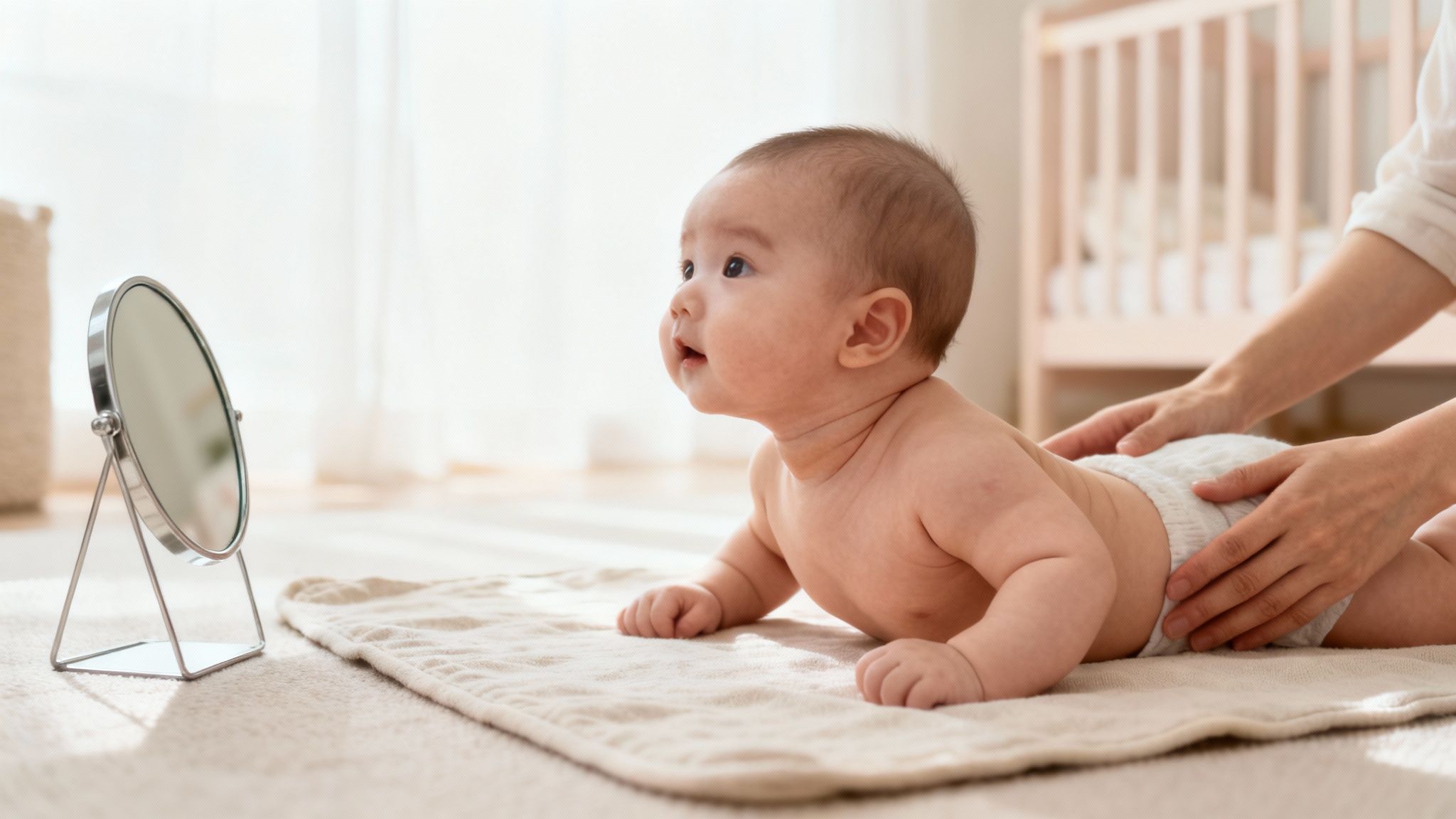
A simple, baby-safe mirror is often one of the most powerful tools for those early days of tummy time. Babies are naturally fascinated by human faces. Their own reflection is no exception. This curiosity is a brilliant motivator. It encourages them to lift their heads and push up on their arms to get a better look.
This simple act of looking at themselves strengthens their neck, shoulder, and upper back muscles. By placing a mirror right in front of them, you encourage them to hold that tricky head-lift for just a little longer. This builds up crucial endurance.
Real-world scenario: Your one-month-old manages about a minute of tummy time before getting fussy. Placing a floor mirror directly in their line of sight captures their attention. Seeing that "other baby" in the reflection keeps them engaged for an extra minute or two. This can double your session length without any extra tears.
A tummy time mirror’s strength lies in its simplicity. It taps into a baby's innate social curiosity to encourage one of the most important tummy time skills: lifting and holding their head steady.
Sensory water mats for cause-and-effect learning
Once your baby has better head control, usually around the three to four-month mark, a sensory water mat is a fantastic next step. These mats are filled with a small amount of water and little floating shapes. They create a squishy, engaging surface for them to explore.
When your baby pushes down on the mat, the water moves and the shapes inside swirl around. This is a brilliant first lesson in cause and effect. It teaches them that their actions make things happen in their environment. It motivates them to push up, shift their weight, and use their hands to pat and poke.
Real-world scenario: Your four-month-old can push up on their hands but gets bored pretty quickly. A water mat introduces a whole new sensory experience. They might happily spend ten minutes pressing on the mat, trying to bat at the floating fish. This strengthens their arms and core as they shift their weight from side to side.
Activity gyms as versatile play hubs
An activity gym is often seen as an all-in-one play solution, and for good reason. It combines a soft mat with an overhead arch of dangling toys. This offers stimulation from different angles. For tummy time, the focus shifts from the hanging toys to the mat itself and any features you can position at eye level.
Many modern gyms come with detachable toys, mirrors, and crinkly fabrics built right into the mat. This versatile design means it grows with your baby. It supports play on their back, tummy, and eventually, in a seated position.
Real-world scenario: You work with a smaller space and want one toy that does it all. An activity gym gives you a dedicated, comfy spot for tummy time. You can unhook a crinkle toy from the arch and place it in front of your baby. Then, use the built-in mirror for head-lifting practice, all without needing several separate toys.
High-contrast flash cards for newborn focus
For a newborn, the world is still a bit blurry. Their vision is best at picking up simple, bold patterns in black, white, and red. This is why high-contrast flash cards are one of the best tummy time toys for the 0–2 month age group.
These cards could not be simpler, but they are incredibly effective. Propping a few cards up in front of your baby gives them something clear to focus on. This encourages them to lift their head and turn it from side to side. That simple act of visual tracking is what builds those essential neck muscles.
Real-world scenario: You try to fit in short, frequent tummy time sessions throughout the day. High-contrast cards are portable and easy to set up anywhere. You can do a quick two-minute session on your Wallaby Collective play mat in the living room, using the cards to keep your newborn calm and focused.
Soft crinkle books for multi-sensory engagement
Soft crinkle books are a wonderful choice for babies who are starting to reach and grasp, usually around 2-4 months. They offer both touch and sound stimulation. That crackling noise they make is so satisfying for little ones and reinforces cause-and-effect learning.
These books often have different textures, ribbons, and sometimes even a little baby-safe mirror inside. Because they are lightweight, they are easy for small hands to interact with. This encourages babies to reach forward while on their tummy. This movement is great for strengthening their arms and chest.
Soft toys are a leading category in the Australian baby toy market because they are safe and provide great sensory feedback. You can learn more about these trends in this report on the Australian baby toys market.
This flowchart offers a simple decision guide to help you choose the best tummy time toys based on your baby's current developmental milestones.
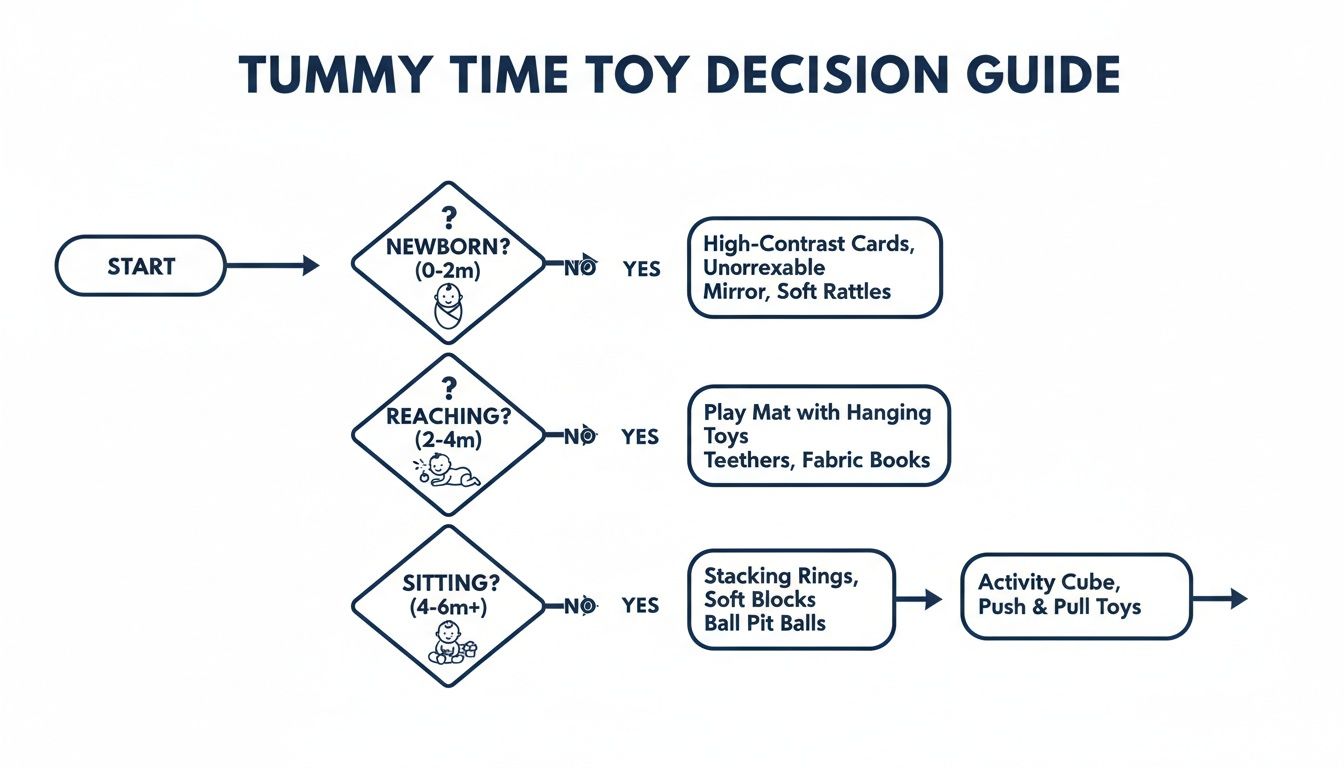
The guide shows how your toy choices can evolve. From simple visual tools for newborns to more interactive options as your baby starts reaching, rolling, and eventually sitting up.
Your essential safety checklist for tummy time toys
Your baby’s safety is everything. While the right tummy time toys can make floor time a little more magical, it is important to know they are completely safe for your little one to explore. This simple checklist will help you choose and look after toys with total confidence.
Let's be honest. Babies learn about their world by touching, feeling, and putting just about everything in their mouths. A safe toy lets them do all that without any risks. This means you get to relax and enjoy watching them play.
First things first: Material and construction checks
Before a toy even makes it through your front door, there are a few checks that are simply non-negotiable. It only takes a moment to inspect a toy for potential hazards, no matter how small they might seem.
Here are the key things to look for.
- No small parts: Check for any bits and pieces that could detach and become a choking hazard. The Australian Competition and Consumer Commission (ACCC) uses a specific cylinder to test for small parts (Source: Toys for children under 3 years, Australian Competition & Consumer Commission, 26 June 2024).
- Non-toxic and BPA-free: Babies will chew on their toys. Always choose items made from non-toxic materials. Look for trusted certifications like OEKO-TEX for any fabric toys.
- No sharp edges or points: Run your hands over the entire toy. It should feel completely smooth, with no sharp edges, rough surfaces, or points that could poke or scratch that delicate skin.
- Secure seams and no loose strings: For soft toys or play mats, give the seams a gentle tug to make sure they are secure. Check for any loose threads, strings, or ribbons longer than 22 cm, as these can pose a strangulation risk.
The right toys do not just support development. They have to meet strict safety standards. Choosing well-made toys from safe materials is the most important first step.
Upholding Australian safety standards
In Australia, we have mandatory safety standards for any toys intended for children under three. These standards cover potential chemical, physical, and mechanical dangers. When you look for tummy time toys, always check that the product explicitly states it meets these local requirements.
This is especially important as market trends shift. For instance, there is a growing demand for eco-friendly and organic toys. This leads to a rise in products made from natural materials like cotton. You can find more insights into these Australian baby toy market trends if you are curious.
Keeping toys clean and maintained
Once the toys are home, keeping them clean is the next step. A simple routine ensures they stay hygienic and safe for daily play, which is easier than it sounds.
Here is how to stay on top of it.
- Follow the washing instructions: Always check the care label first. Many soft toys and fabric play mats are machine washable, which is a lifesaver for a thorough clean.
- Wipe down hard surfaces: For plastic or wooden toys, a regular wipe-down with a baby-safe cleaning solution or a simple mix of vinegar and water does the trick.
- Inspect for wear and tear: Every now and then, give the toys a quick once-over. Look for things like cracks in plastic or fraying seams on soft items. If a toy is broken, it is best to either repair it securely or say goodbye to it to avoid any new hazards.
Creating the perfect tummy time environment
The best tummy time toys really come to life when the setting is just right. A comfortable and inviting space can make a huge difference. It can turn what can sometimes feel like a chore into a really positive, bonding experience. It all starts from the ground up. The surface you choose is the foundation for everything else.
A soft yet firm play mat is the ideal base. Unlike a plush blanket where a baby's face could sink in, a flat, supportive mat offers a safe and stable surface. That little bit of firmness is crucial because it gives your baby the resistance they need to push up, lift their head, and start building that all-important strength.
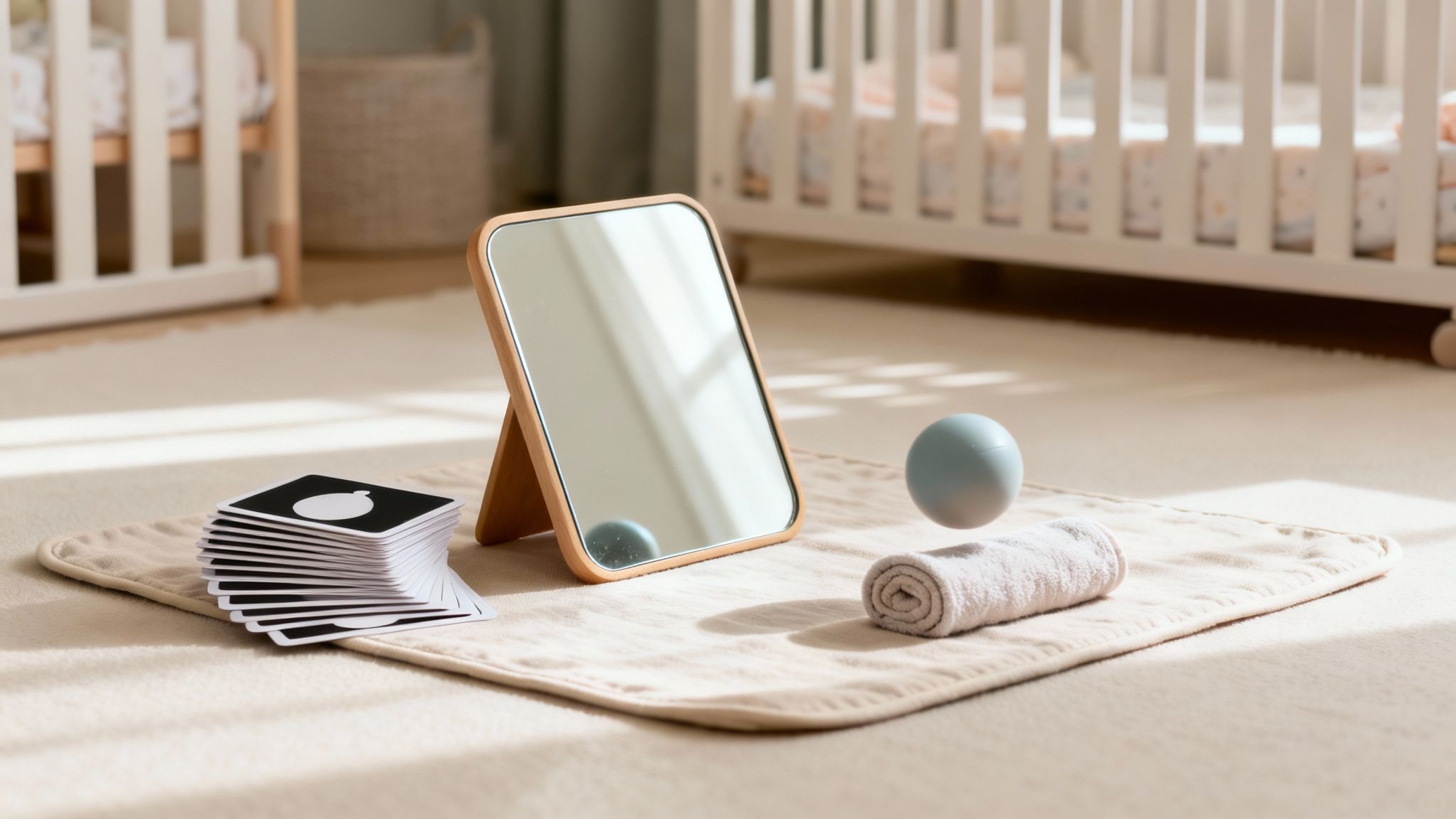
So, how do we use this space to get the most out of playtime?
Arranging toys for maximum motivation
A little bit of strategy with toy placement can turn a simple session into a targeted developmental workout. It is all about creating small, achievable challenges that get your baby moving in new ways. By thoughtfully arranging their favourite things, you can gently guide their exploration and help them master key motor skills.
Here is how you can set up different toys on a play mat to work towards specific goals.
- To encourage head lifting: Pop a baby-safe floor mirror directly in front of them. Babies are fascinated by faces. Their own reflection is an incredible motivator to lift their head for a better peek.
- To promote neck turning: Lay out some high-contrast flash cards in an arc around their head. This encourages them to look from one side to the other. It builds the neck muscles they will need for tracking objects and, eventually, rolling over.
- To motivate reaching: Place a crinkly toy or a textured sensory ball just within their line of sight but slightly out of easy reach. That small challenge prompts them to shift their weight and extend an arm. This is great for strengthening their core and shoulders.
This kind of intentional setup makes sure that playtime is both fun and purposeful.
Your play mat is so much more than just a soft spot on the floor. It is a dedicated zone for learning and discovery. By using its generous surface to position toys strategically, you create a complete and comfortable play area anywhere in your home.
Creating a safe and inviting play zone
A calm, organised space is just as important as the toys themselves. When the tummy time area is free from distractions and clutter, it is much easier for your baby to focus on the task at hand. It also makes the whole experience safer and more enjoyable for everyone.
Think about the atmosphere you create. A dedicated play area signals to your baby that it is time for fun and connection. This consistency helps build a positive association with tummy time. You can learn more about how a well-chosen mat supports this in our guide to tummy time mats for infants.
Here are a few simple tips for setting up the perfect play zone.
- Choose a calm location: Find a spot away from high-traffic areas and loud noises. A quiet corner of the living room or nursery works beautifully.
- Ensure good lighting: Natural light is lovely, but make sure it is not shining directly into your baby's eyes. Soft, indirect light is best.
- Rotate your toys: Keep things interesting by only having two or three toys out at a time. Swapping them out every few days prevents overstimulation and keeps your baby engaged with what is in front of them.
A clutter-free space encourages focus. It is worth exploring some effective strategies for organizing kids' toys to keep the tummy time area inviting and safe. This simple habit makes setup and cleanup much quicker, which helps you stay consistent with your daily routine.
Next steps? Let's dive into making tummy time a fun, interactive part of your day.
Your tummy time success plan
Let’s put everything together into a simple plan to make tummy time a positive part of your day. This little checklist is your go-to guide for creating the best possible experience. It will help you feel confident and prepared for every session.
Success starts with timing. Try to find moments when your baby is happy, fed, and alert, not when they are sleepy or getting fussy. This sets a positive tone right from the start.
Your daily tummy time checklist
Here is a straightforward routine to follow. The real key is consistency and gentle encouragement. This helps turn floor time into a cherished activity rather than a chore.
- Choose the right time: Pick a wake window when your baby is feeling content. A short session after a nappy change or a good nap often works wonders.
- Start small: For newborns, even 30 to 60 seconds a few times a day is a fantastic start. You can gradually add more time as your baby gets stronger and more comfortable with it.
- Get down to their level: Lie on the floor face-to-face with your little one. Your presence is the best encouragement they can get. They will love seeing you up close, hearing your voice, and sharing smiles.
- Rotate engaging toys: Keep things interesting by swapping out one or two age-appropriate toys every so often. A mirror one day and a crinkle book the next can prevent boredom and keep them motivated to lift their head.
Tips for a happy tummy timer
What if your baby resists tummy time? This is completely normal, so do not feel discouraged. A little extra support can make all the difference in helping them feel secure.
If your baby is struggling, try placing a small, tightly rolled-up towel under their chest and armpits. This gentle lift gives them extra support, making it easier to lift their head and look around.
This simple adjustment can make a huge difference in their comfort and how long they are happy to stay in the position. For some brilliant ideas you can use in your baby's routine, explore these 8 fun and engaging tummy time activities.
Ultimately, a successful tummy time is all about creating a positive, safe, and engaging space where your baby can build strength through play. For a deeper look into creative ways to play, check out these other fun tummy time activities to try with your baby.
A few common tummy time questions
Even with the best toys and a beautiful play mat, questions always pop up. Let's tackle some of the most common ones to give you a bit more confidence as you and your little one navigate tummy time together.
How many tummy time toys do I really need?
Honestly, you do not need a mountain of toys taking over your living room. When it comes to tummy time, it is all about quality over quantity.
Having just two or three well-chosen, age-appropriate toys that you can rotate is far more effective. This simple approach keeps your baby curious and engaged without feeling overwhelmed.
A great starting trio could be:
- An unbreakable floor mirror for those first moments of self-discovery.
- A high-contrast book or a set of flash cards to help with visual tracking.
- A tactile toy, like a soft crinkle book or a sensory ball, to encourage reaching.
The goal is to create meaningful interaction, not to overwhelm your baby with endless options. A few select items will create a much calmer, more focused space for play.
What if my baby dislikes tummy time even with toys?
First, know that this is incredibly common. You are not alone, and it is no reflection on you or your baby. The key is gentle persistence and finding what works for your little one.
Start with tiny sessions. Even 30 seconds at a time is a win. You can begin with your baby lying on your chest or lap, where they feel safe and connected to you. It is all about building positive feelings around the position.
As they get a little stronger, you can gradually move them to their play mat. Use their favourite toy to distract and engage them. And do not forget to get down on their level. Your voice, songs, and eye contact are incredibly comforting.
A small, tightly rolled-up towel placed under your baby’s chest and armpits can offer a little extra support. This slight lift often makes it easier for them to raise their head, which can reduce frustration and make the whole experience more comfortable.
When should I introduce different kinds of toys?
Timing the introduction of new toys is a simple way to align playtime with your baby's development. It keeps things fun and ensures the challenge is just right, not too easy, not too hard.
For newborns (0–2 months), their world is all about visual development. Simple, high-contrast toys like black-and-white cards or a floor mirror are perfect for catching their attention and encouraging those first head lifts.
Around 2–3 months, you will likely notice them starting to reach and grasp. This is the perfect time to introduce tactile toys like soft crinkle books or lightweight sensory balls that are easy for tiny hands to hold.
Interactive toys, like activity gyms or sensory water mats, are great from 3–4 months onwards. By this stage, babies usually have better head control and are more curious. This makes them ready for toys that teach a bit about cause and effect.
At Wallaby Collective, we believe in creating calm, beautiful spaces for little ones to learn and grow. Our OEKO-TEX certified linen play mats provide the perfect safe and stylish foundation for all your tummy time adventures. Discover our collection and find the ideal mat for your home.